

Panama Canal & Impact Of Climate Crisis
The Panama Canal is one of the main maritime routes for transporting goods from Asia to America. Goods have been traded between these two continents through this waterway for ages. Currently, the Panama Canal is facing a serious crisis. Reports suggest that both sides of the Panama Canal are crowded with ships due to the impacts of Climate Change and policies amended by various countries. Such a plight of the Panama Canal has never been seen before.
According to different newspaper reports, more than 200 ships are waiting on both sides of the Panama Canal to cross this artificial 82km-long waterway. Ships have no other option, but to wait about four days on an average to cross the canal. Bloomberg recently reported that some vessels had to wait for more than 20 days there before reaching their destinations a couple of months ago. Experts are of the opinion that the decrease in water level of the canal has triggered this problem. They believe that water level along the Panama Canal is gradually receding due to Climate Change and prolonged drought in some countries in this region.
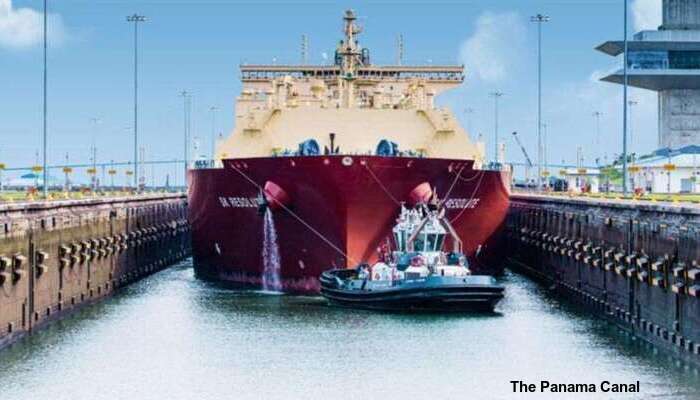
Gatun Lake, a freshwater artificial lake to the south of Colón (Panama), is one of the main sources of water supply of the Central American country. At approximately 26mt (85ft) above sea level, the lake forms a major part of the Panama Canal, carrying ships 33km (21mi) of their transit across the Isthmus of Panama. As the water level of Gatun Lake has decreased significantly in the past seven years, the water level of the Panama Canal, too, has dropped. Also, there are around 1,400 islands scattered around Panama, and most of these islands are experiencing an acute drought for the first time in the last seven decades. It is estimated that the drought has so far caused a financial loss of around USD 200 million.
The Panama Canal Authority (ACP) has introduced various restrictions in order to preserve the waterway. However, the concerned authorities have admitted that the restrictions failed to change the scenario. As per the new ACP rule, no more than 32 ships are allowed to sail through the Panama Canal per day.

At present, ships are carrying less cargo because of the falling water level. According to a report published by Yahoo News, Panama is the busiest country as far as maritime trading is concerned. On an average, nearly 40% of US cargo ships pass through the Panama Canal each year. The problems faced by the Panama Canal due to the effects of Climate Change are expected to increase in the future, and it could directly affect the economy of different countries.
Experts fear that if the water level of the Panama Canal continues to decrease, then inflation in the US may increase. As a result, the prices of various imported products may also increase in the US. Transportation of goods through the Panama Canal has increased in recent years because of the expansion of global trade and the advent of e-commerce. However, the crisis has caused worry in the US and also in various other countries. Interestingly, the ACP is hopeful that the Panama Canal problem would soon be resolved, as work is going on 24×7 in an attempt to overcome the crisis.
Boundless Ocean of Politics on Facebook
Boundless Ocean of Politics on Twitter
Boundless Ocean of Politics on Linkedin
Contact: kousdas@gmail.com

 ISMC
ISMC Boundless Ocean Of Politics