

5,500-Year-Old City Gate Excavated
In what may be seen as a significant archaeological discovery, researchers unearthed the oldest known gate in Israel in the third week of August 2023. The Israel Antiquities Authority issued a statement on August 15, mentioning that the 5,500-year-old imposing stone and mud-brick passageway to the ancient city of Tel Erani offers a glimpse into ancient urbanisation in the region.
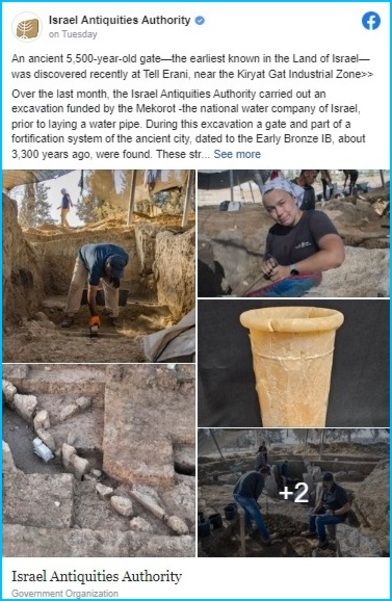
According to the statement, researchers came across this structure during excavations near an industrial zone in Kiryat Gat. They also unveiled a portion of a fortification system, dating to the Early Bronze Age (approximately 3,300 years ago). They were about to install a water pipeline there. The Antiquities Authority claimed that the discovery would provide valuable insights into the development of strategic defence systems in ancient times.
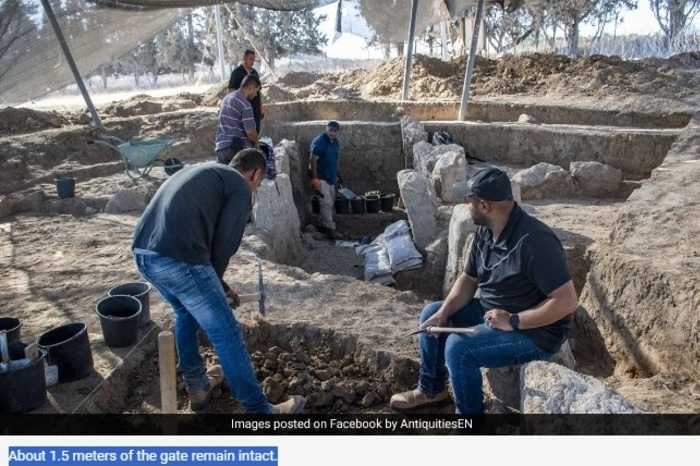
Daniel Master, a Professor of Archaeology at Wheaton College, Illinois, said: “When we started digging, we found that this area between the mud bricks was filled with gravel, which is very unusual, so we started removing the gravel.” He told the media: “We kept digging down further, and it was preserved at a depth of 1mt, then 2m, then 3mt, then 4mt. This structure was totally intact, and suddenly we realised we were dealing with the foundation of a building or a superstructure that had been constructed at the top of the site.”
Professor Master informed the press that the recently uncovered complex consists of more than 9,000 unfired mud bricks, and they were stacked to create a tower and the domed passageway. According to the archaeologist, the 2mt-long passageway was built in corbelled fashion. It is an architectural technique where layered bricks are progressively stepped inward in order to create a gradually narrowing roof. This is the earliest documented example of corbelled architecture in Israel, although the technique was widely used in Mesopotamia during the same period, around 3,800 years ago.

The Times of Israel reported on August 17 that the height of the round knoll of Tel Shimron is 70mt (230ft, above the Jezreel Valley). However, it is not high enough compared to a massive monument built by the rulers of the ancient acropolis during the Middle Bronze Age (nearly 3,800 years ago). The monument covers nearly the entire top of the hill. Built with mud bricks using the most advanced architectural technology of the time, the monument raised the height of the hill by an additional 5mt (15ft), while the complex extends around 1,200sqmt (13,000sqft) across the top of the hill. It is about the size of an Olympic swimming pool.
According to Professor Master, the monument was well preserved because it was completely filled in with gravel soon after it was constructed, and the gravel supported, as well as protected, the arches. He believes that very few people walked on it after construction, as the floor and the stairs of the passageways, also built of mud bricks, show very little wear and tear. However, the purpose of constructing such a huge monument has stumped the archaeologists. “Why would you put so much effort into something already 70mt (230ft) above the valley floor, and make it 75mt (245ft) above the valley floor?” asked Professor Master. “What would it mean for the landscape around and how people used the site? What are the social implications for building something so massive at the top of the site?” he further asked.
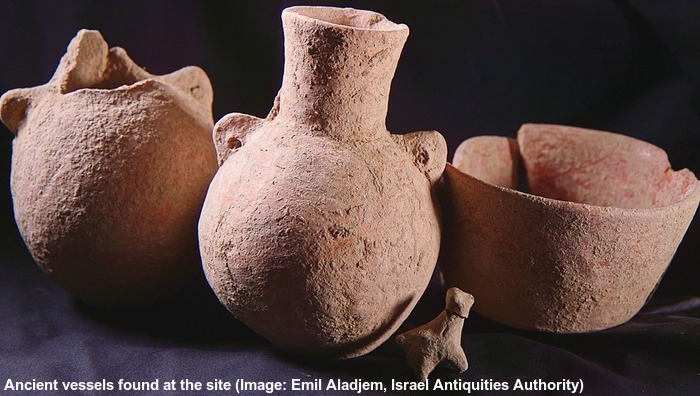
Initially, the archaeologist thought that the construction might have been walls of an ancient fortified city in order to protect the area from conquering Egyptian Armies. However, Professor Master found gates at every place, and they led to a dead end. A section of archaeologists believe that the monument could have religious significance, as they discovered a seven-spouted vessel, lying in ashy debris, at the entrance to the main passageway. This sort of vessel is called a Nahariya bowl, since a similar vessel from the same period of time was discovered in Nahariya. People used them while performing religious rituals.
Emily Bischoff, the Director of the Excavation Project carried out by the Israel Antiquities Authority, stressed: “This is the first time that such a large gate dating to the Early Bronze IB has been uncovered. To construct the gate and the fortification walls, stones had to be brought from a distance, mud bricks had to be manufactured, and the fortification walls had to be constructed. This was not achieved by one or a few individuals. The fortification system is evidence of social organisation that represents the beginning of urbanisation.” For his part, Israel Antiquities Authority researcher Martin-David Pasternak stated: “It is probable that all passers-by, traders or enemies, who wanted to enter the city had to pass through this impressive gate.“
Meanwhile, Dr Yitzhak Paz, an Israel Antiquities Authority archaeologist specialising in the Early Bronze Age Period, explained: “Tell Erani, which is about 150 dunams (37 acres) in size, was an important early urban centre in this area in the Early Bronze Period. The Tell site was part of a large and important settlement system in the southwestern area of the West Asian nation during this period. Within this system, we can identify the first signs of the urbanisation process, including settlement planning, social stratification, and public building.”
Dr Paz further said: “The newly uncovered gate is an important discovery that affects the dating of the beginning of the urbanisation process in the country. The extensive excavations carried out by the Israel Antiquities Authority over recent years have led to dating the beginning of urbanisation to the end of the fourth millennium BCE, but the excavations carried out at Tell Erani have now shown that this process began even earlier, in the last third of the fourth millennium BCE.“

It may be noted that Tel Erani is a 150-dunam (or 37-acre) area, and its origins are closely linked to the ancient Philistines. Most probably, the Babylonians destroyed the city located on the present-day outskirts of Kiryat Gat in the 6th Century BCE.
Boundless Ocean of Politics on Facebook
Boundless Ocean of Politics on Twitter
Boundless Ocean of Politics on Linkedin
Contact: kousdas@gmail.com

 ISMC
ISMC Boundless Ocean Of Politics