

Uncle Tom’s Cabins In Pakistan
A Meghwar family in Pakistan had borrowed a small amount of money from a local feudal lord almost two decades ago to pay hospital bills. Since then, members of that family have been trapped in slavery. They remain in Pakistan as a symbol of exploitation and oppression by the feudal lord!
The Meghwar community, also known as Meghwar Vil or Sindhi Vil, live in the Pakistani Provinces of Sindh, Punjab and Balochistan. This community is one of the few Hindu communities in Pakistan who are considered as Dalit or lower caste people. The family of Basanti Meghwar is among the Meghwars living in Sindh. Basanti and her son, Punjo Meghwar, had borrowed a small amount of loan from a local feudal lord 23 years ago to pay off outstanding hospital bills. Since then, Basanti, Punjo, Punjo’s wife, Punjo’s 12-year-old son Dilip have been working at a brickyard owned by the feudal lord.
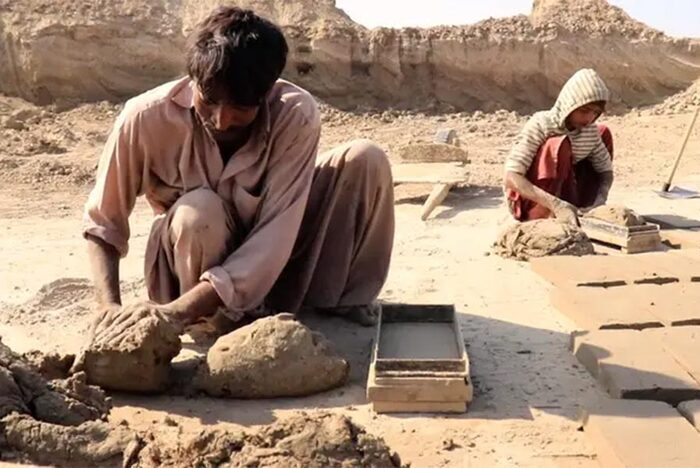
Punjo and his family earn PKR 400 (USD 1.40) per day as wage for working hard at the brickyard situated near the Thar desert. Of this, the feudal lord deducted PKR 200 as interest of the loan borrowed by the Meghwar family. Punjo had borrowed the money from the feudal lord 23 years ago against a thumb impression. His family has no idea about the interest rate or what was written in the contract. Even Punjo has not seen the contract since he borrowed the money. All they know is that the money has not yet been repaid. The Meghwar family only knows that the feudal lord shall receive about USD 604.62 from them. The lender visits the family every month and says: “There is a lot left to repay the loan. So, you have to keep working at my brickyard.“
The feudal lord earns PKR 50,000 (USD 175.12) in a month by selling bricks made by the Meghwar family. However, the burden of debt is still on the shoulders of Punjo. Punjo, his 70-year-old mother, and son Dilip wake up early every day and start making bricks. They get the only break during lunch, and then keep working till the evening. They have to cut clay, pour water into it, make mud, and make bricks. In the evening, they return to their small one-room hut situated in the corner of the brickyard. They even spend their nights there.

As making bricks requires intensive manual labour, the body gets tired easily. Still, Punjo and his family members have to spend the entire day making bricks, standing in front of the furnace. In July 2022, three workers died after falling into the furnace. However, they have to work constantly, risking their lives. There is no respite for Punjo’s teenage son, Dilip, too. It takes about a month to make bricks from clay. In Pakistan, a lot of money is involved in the brick trade. Unfortunately, the condition of the Meghwar family remains the same. Punjo recently told a media person: “I don’t know when I will be free from this hell… when I can repay the loan. This pain is unbearable. I see my son dying in front of my eyes every day.“
Child labour is illegal in Pakistan. However, data shows that one out of three brickyard workers is a minor in the South Asian country. Dilip said: “I am 12 now. I still cannot read and write. After working all day, I feel back pain. My father cannot say exactly how many more days we have to work here.” Apart from excess heat, breathing is dangerous in the brickyard because of dust. According to doctors, exposure to carbon monoxide and sulphur can kill brickyard workers, especially children.

Not only the Meghwar family, other families, like Punjo’s, are living like slaves in Pakistan. Rafiq Gulzar, a resident of Punjab Province, is one of them. Rafiq had to borrow money from the owner of a local brickyard in 2018 to pay dowry at the time of his daughter’s marriage. In return, he promised to make 1,000 bricks per day at a brickyard in Jhang District of Punjab. A few months later, Rafiq was sold to another brickyard owner in Bath village near Lahore. The owner provided his family with a two-room house in front of the brickyard for accommodation.
This type of modern-day slavery is very common in Pakistan. According to the Global Slavery Index, nearly 2.5 billion people live as debt-ridden slaves in Asia and the Pacific Region alone. Despite a lot of evidence and media reports, the Labour Department of Sindh Government has claimed that it is unaware of any such slavery. The Department has further claimed that there is no official record of those families and minors, living as slaves for years. According to various reports, the names of Punjo, Rafiq, and others are not there in the official register because of special relations between the owners of the brickyards and top Government officials.

Zahid Thebo works with the Society for the Protection of the Rights of the Child (SPARC) to monitor child labour in brickyards. This NGO fights court cases on behalf of families trapped in slavery. So far, SPARC has rescued around 17,000 people from slavery. Thebo has stressed: “When someone is released, we get emotional satisfaction from their smiles and happiness, and also from the bright faces of the little children. There is no greater peace of mind than this.”
After being freed from the brickyard owners and feudal lords, they were taken to a camp in Azad Nagar. Those families are able to earn wages by working in brickyards there, although they do not have to pay anyone. A number of residents of Azad Nagar have said that they feel lucky to have escaped the cycle of slavery. However, there is not enough water in the camp. Also, there is no school. SPARC recently appealed to the Government of Pakistan for financial assistance.
Boundless Ocean of Politics on Facebook
Boundless Ocean of Politics on Twitter
Boundless Ocean of Politics on Linkedin
Contact: kousdas@gmail.com

 ISMC
ISMC Boundless Ocean Of Politics