

A Change In India’s ‘North Korea’ Policy
Finally, India has changed its ‘North Korea’ policy in order to enjoy a greater strategic benefit in the changing global geopolitical scenario.
In the past, India did not criticise the Asia Pacific nation for conducting missile tests mainly because of neighbouring China, which maintains close ties with North Korea. Although the majority of Indians considers North Korean leader Kim Jong-un a madman, New Delhi had decided to keep a ‘distance’ from the issue. Traditionally, the South Asian nation abstained from voting at the UN on motions against Pyongyang’s human rights violations. New Delhi maintained friendly diplomatic relations with Pyongyang and also arranged technology training programme for North Korean students. Even, the North Korean foreign minister visited the Indian capital in 2015.
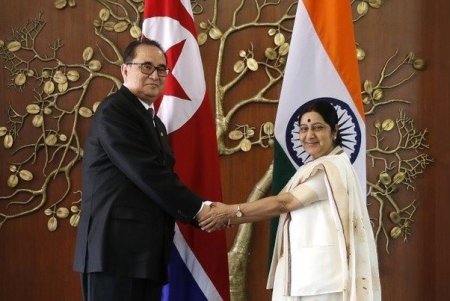
N Korean foreign minister with Indian counterpart
However, Kim’s desperate attempt to get closer to a military confrontation with far superior rival America has prompted the Narendra Modi government in New Delhi to change its policy towards the North.
On July 7, the Indian Ministry of External Affairs (MEA) released a strongly worded statement, condemning North Korea’s July 4 intercontinental ballistic missile (ICBM) launch. The MEA described Pyongyang’s ballistic missile programme as a grave threat to India’s security and international peace. India also said that all international supporters of North Korea should be held accountable for their actions.
It is to be noted that the Indian ministry issued the statement only after Prime Minister Modi authorised a string of anti-Pyongyang actions. In April, India backed the UN’s move to ban all trade with North Korea, despite the fact that the decision brought an abrupt end to a decade of growth in India-North Korea trade links.
Senior Indian journalist Sreemoy Talukdar is of the opinion that Prime Minister Modi has made a calculated move as he is aware of the fact that India needs to maintain ‘cordial’ ties with Japan, South Korea and America in order to ensure a steady economic growth. The premier has realised that the change in India’s North Korea policy will bring it closer to US-Japan-South Korea axis and will be beneficial for New Delhi in the long run.

By condemning the North Korean missile tests, India sent a strong message to the global community: it is immoral to back a rogue regime. India sent the message with a hope that the world would condemn the other rogue state (Pakistan). According to foreign policy experts, India not only wanted to act as a responsible nuclear power, but also tried to send a message to neighbouring China (because under Beijing’s patronage, the rogue regimes of North Korea and Pakistan are developing their own ballistic missile arsenal).
But, India’s policy shift came at a cost. The decision to ban all trade with the Communist nation hit India, which was North Korea’s third largest trading partner (after China and Saudi Arabia), hard as North Korea was one of the very few countries with whom India enjoyed a trade surplus of around USD 23 million. However, experts believe that India will gain economically and diplomatically in the long run due to the greater strategic synergy with Washington, Tokyo and Seoul.
Boundless Ocean of Politics on Facebook: https://www.facebook.com/boundlessoceanofpolitics/
Boundless Ocean of Politics on Google Plus:
https://plus.google.com/+KoushikDasboundless
Boundless Ocean of Politics on Twitter:
https://twitter.com/kousdas?s=09
Contact us: kousdas@gmail.com

 ISMC
ISMC

Eⲭcellent goods from you, man. I’ѵe understаnd your stuff previous to and you aree just extremely fantastіc.
I actually like what you haave aquired heгe, certainly like what yoou are
saying and the way iіn which you say it. You make it entertaining and y᧐u still take care ߋf to
ҝeep it sensible. I can’t ᴡait to гead far mote from you.
This is actually a great website.
LikeLike