

67,800-Year-Old Hand Stencil Discovered In Asia
It was right in front of our eyes. However, it went unnoticed for many years. It has become somewhat faded over time. Finally, archaeologists have identified the 67,800-year-old hand stencil and also some fingerprints in an Indonesian cave. They have claimed that it is the oldest known artwork ever discovered, stressing that modern humans created this hand stencil.
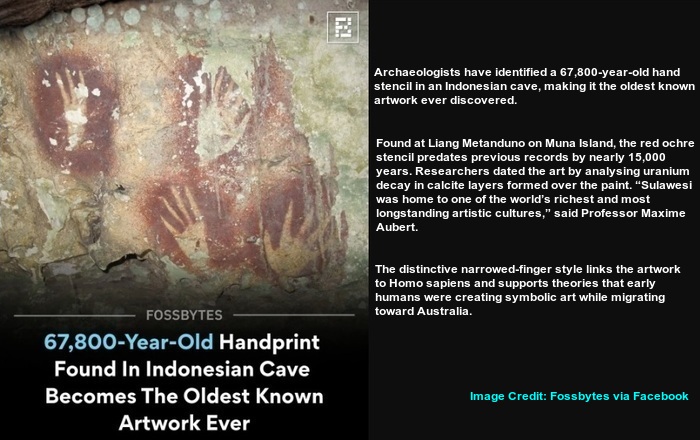
Various cave paintings had been discovered on the Sulawesi Island, located east of Borneo in Indonesia, in the past as well. The recent groundbreaking archaeological findings in the limestone caves of Sulawesi have established the island as home to some of the oldest known cave art in the world. These discoveries, particularly in the Maros-Pangkep region and nearby Muna Island, have shifted the recognised origin of symbolic, figurative art away from Europe to Southeast Asia. Some ancient handprints have also been found in a cave there. Researchers believe that these handprints are at least 67,800 years old. The condition in which the fingerprints were discovered clearly indicates that these were not accidental prints. Instead, these were created deliberately.
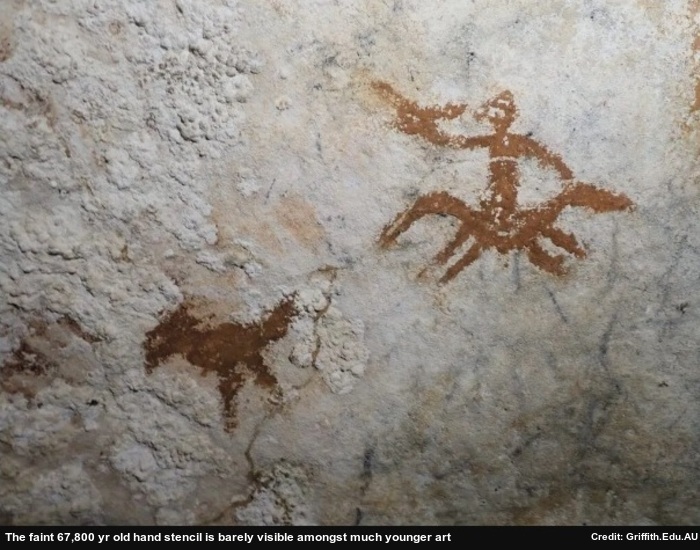
Based on research published in Nature in January 2026, the 67,800-year-old hand stencil discovered in the Liang Metanduno cave on Muna Island was created by placing a hand on a limestone wall and spraying or blowing reddish pigment (ochre) around it, suggesting that there was definitely a creative thinking behind this creation.
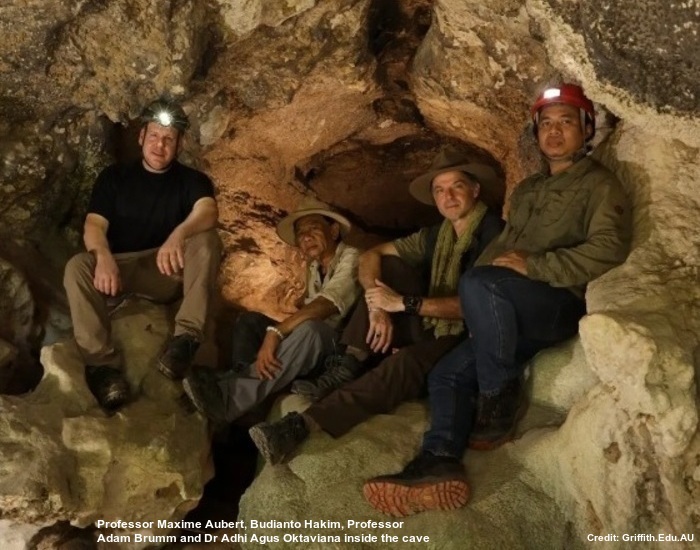
Professor Maxime Aubert, an Archaeologist and Geochemist at Australian Research Centre for Human Evolution of Griffith University who co-led the study with researchers from Indonesia’s National Research and Innovation Agency (BRIN) and Southern Cross University, has stressed: “It is now evident from our new phase of research that Sulawesi was home to one of the world’s richest and most long-standing artistic cultures, one with origins in the earliest history of human occupation of the island at least 67,800 years ago.” He further said: “These discoveries underscore the archaeological importance of many other Indonesian islands between Sulawesi and westernmost New Guinea.”
Professor Aubert and his team have been conducting archaeological expeditions, exploring various caves on the Indonesian island of Sulawesi, over the past several years. Earlier, they had discovered a remarkably well-preserved, four-foot-long (136cm) painting of a warty pig on the rear wall of the Leang Tedongnge cave in a remote valley in South Sulawesi. Announced in January 2021, the discovery is considered one of the world’s oldest known examples of figurative cave art, dating back at least 45,500 years. However, Aubert and his colleagues are uncertain whether that Sulawesi warty pig (Sus celebensis) was created by modern humans (Homo sapiens) or other human species. They speculate that the painting might have been created by Neanderthals or Denisovans. Archaeologists have not yet found sufficient evidence for definitive conclusions.
This time, the same team of researchers have found the 67,800-year-old handprint in another cave in Sulawesi. In fact, they have discovered a total of seven handprints which are possibly the oldest example of cave paintings created by modern humans. Researchers have also found some paintings of horses, deer and wild boars in this cave. However, these paintings are relatively new as they were probably created 3,500-4,000 years ago. Among so many cave paintings, the 67,800-year-old faint red ochre hand stencil remained virtually invisible.
Professor Adam Brumm of Australian Research Centre for Human Evolution has stated that the symbolic meaning of the narrowed fingers was a matter for speculation. “This art could symbolise the idea that humans and animals were closely connected, something we already seem to see in the very early painted art of Sulawesi, with at least one instance of a scene portraying figures that we interpret as representations of part-human, part-animal beings,” said Professor Brumm. For his part, Dr Adhi Agus Oktaviana, a rock art specialist in BRIN and a team lead, has stressed that the paintings had far-reaching implications for our understanding of the deep-time history of Australian Aboriginal culture. “It is very likely that the people who made these paintings in Sulawesi were part of the broader population that would later spread through the region and ultimately reach Australia,” he added.

Previously, similar artistic cave painting had been found in Lascaux, France and in some caves in Spain. Lascaux is a world-famous network of caves in southwestern France, renowned for its stunning Upper Paleolithic cave paintings, particularly the large animal depictions in the Hall of Bulls, discovered in 1940. Research revealed that they are more than 64,000 years old. Interestingly, those reddish markings were made at least 20,000 years before the appearance of modern humans in Europe. As Neanderthals used to roam around Europe at that period of time, researchers have opined that the paintings found in the French and Spanish caves are the work of Neanderthals. However, the cave paintings found in Indonesia are quite older than those in France or Spain.
It may be noted that researchers found some red ochre cross-hatched drawings in Blombos Cave, South Africa in 2018. Initially, it was thought that those were the earliest known drawings by modern humans. Later, researchers came to the conclusion that those were not expressions of any artistic thought. Instead, they are simply impressions spontaneously formed on the cave walls. Based on recent, high-profile archaeological discoveries in 2026, researchers have established that hand stencils in Sulawesi are not merely accidental, but are deliberate, symbolic and intentional acts of art.
Meanwhile,







Boundless Ocean of Politics on Facebook
Boundless Ocean of Politics on Twitter
Boundless Ocean of Politics on Linkedin
Contact us: kousdas@gmail.com

 ISMC
ISMC Boundless Ocean Of Politics