

US Ditches India
A silent but significant change in global geopolitics is going on. The US recently launched Pax Silica, a major strategic initiative to build a resilient, secure and innovation-driven global silicon supply chain, covering everything from critical minerals to Artificial Intelligence (AI) infrastructure. Besides the US, the other members of this alliance are Japan, South Korea, Singapore, the Netherlands, Britain, Israel, the United Arab Emirates (UAE) and Australia. Interestingly, the exclusion of India from this US-led initiative signals a major shift in global tech power dynamics.
As expected, parties in the Opposition in the South Asian nation have become vocal about the future trajectory of Indo-US economic and strategic relations. The US has excluded India from the Pax Silica initiative at a time when the bilateral trade agreement remains elusive in spite of high-level political and technological discussions.
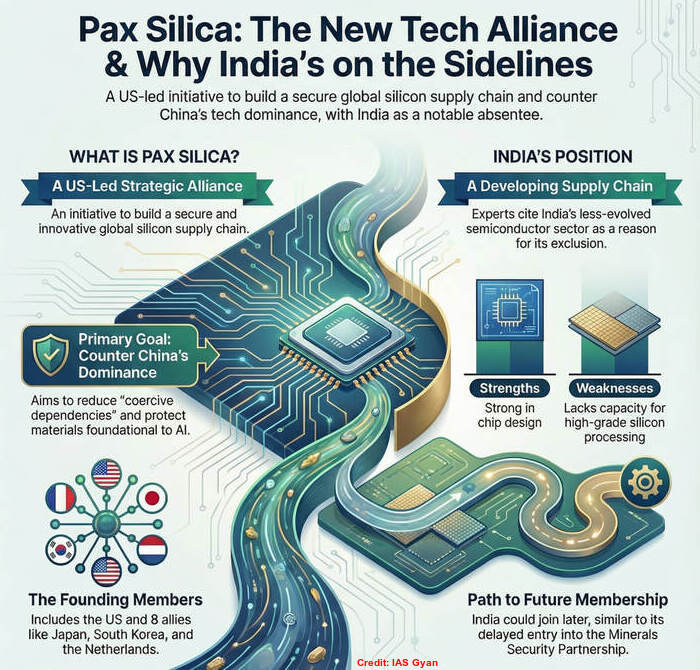
Although Washington DC has highlighted Pax Silica as its main initiative in the fields of AI and supply chain security, political analysts widely view the initiative as a strategic move to counter China’s growing dominance in critical technology supply chains, particularly in AI, semiconductors and rare earth minerals. Notably, China currently controls nearly 70% of the global rare earth minerals extraction sector, apart from playing a central role in several critical technologies, as well as defence, supply chains and green energy (EVs and wind turbines).
In such a situation, the main objectives of Pax Silica are to jointly identify vulnerabilities and opportunities across the AI supply chain, encourage joint ventures and co-investment arrangements, apart from protecting sensitive technologies and critical infrastructure from falling into the hands of “countries of concern“. Needless to say, the real objective of the US is to seize the dominance of China in the field of technology with the help of Pax Silica.
Many believe that the US has included countries that are at the forefront of AI and semiconductor supply chain sectors in this initiative. As India is not advanced in these fields (despite having a massive talent pool and significant AI skill penetration), the US has excluded it from the initiative. Others are of the opinion that the Donald Trump Administration is trying hard to reshape the global technology landscape after launching a Tariff War with various countries, including India and China.
Recent events suggest that the US companies and the Trump Administration are actively applying pressure on India in an attempt to gain greater access to the Indian agricultural market, particularly for products, like corn, soybeans, cotton and dairy. It may be noted that Mexico, despite not being among India’s top 20 trading partners, recently announced additional tariffs of up to 50% on selected Indian imports (starting on January 1, 2026), marking a significant shift in bilateral trade dynamics. President Trump, too, has warned that more tariffs could be imposed on Indian rice, saying that India should not be dumping its rice into the US. The president has stressed that he would take care of the situation, adding that tariffs could “easily resolve the problem“. There is a clear indication that New Delhi needs new diplomatic partnerships to protect its long-term economic and strategic interests.
At the same time, India needs deep expertise via focussed education (AI/semiconductor courses), strong Public-Private Partnerships (PPPs), robust R&D, better infrastructure, strategic skill development and aligned government policies (like PLI) to become a global partner in AI and semiconductors from an applicant.
Meanwhile,


Boundless Ocean of Politics on Facebook
Boundless Ocean of Politics on Twitter
Boundless Ocean of Politics on Linkedin
Contact us: kousdas@gmail.com

 ISMC
ISMC Boundless Ocean Of Politics