

Women Buried With Around 270,000 Beads
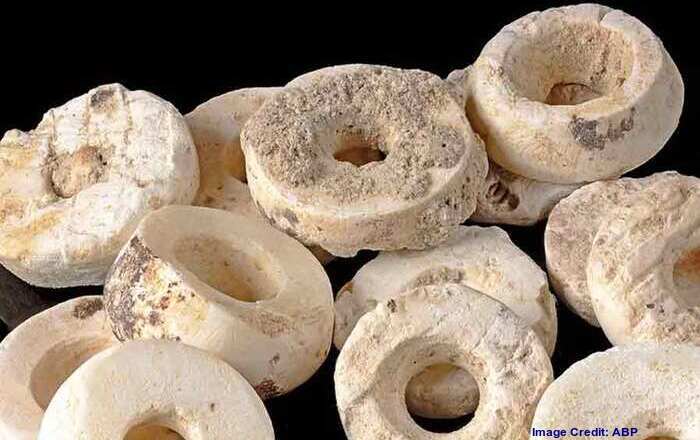
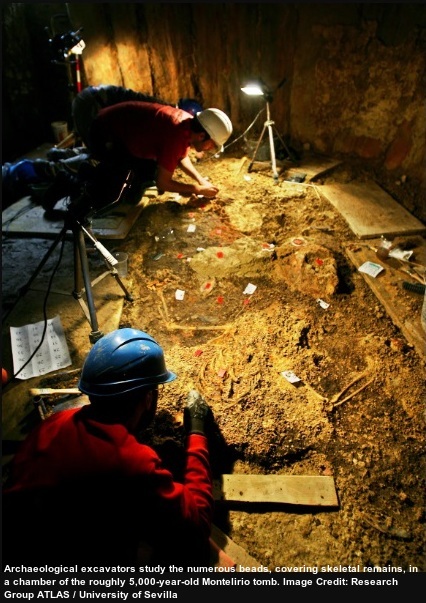
Archaeologists recently found around 270,000 white beads while excavating 5,000-year-old graves of women at the Montelirio Tholos burial site in Seville, Spain. Although archaeologists discovered those graves in 2008, they carried out excavation works there in January 2025. In a rare first, researchers found so many beads together. Interestingly, all the beads, primarily made from marine shells, bones and stones, have a hole in the middle, suggesting they were part of elaborate, ceremonial clothing.
It may be noted that similar beads were also found in the tomb of the Ivory Lady, located about 100mt from the Montelirio tomb. Researchers discovered the skeleton of the Ivory Lady, along with an elephant’s tusk, an ivory comb, a crystal dagger, an ostrich eggshell and a flint dagger inlaid with amber and other valuable objects. Initially, they thought that the tomb belonged to an important leader after examining the bones. Re-examination of them suggested in 2021 that it was the skeleton of a woman.
Leonardo García Sanjuán, the Professor of Prehistory at the University of Sevilla, has stressed that historians’ ideas about the woman, as well as the society, changed after the discovery of the tomb of the Ivory Lady. Previously, researchers used to assume that the skeleton belonged to a man, as they found a sharp weapon with it. However, the discovery of the Ivory Lady hit the root of gender inequality hard. According to Professor Sanjuán, the Montelirio tomb might have been built for descendants of the Ivory Lady. However, it has not yet been examined whether the Ivory Lady had any connection to the people buried at the same place.
The team of researchers examined the bones of 20 skeletons found in one of the chambers of the tomb to determine their gender in January 2025. While 15 of those skeletons belonged to women, researchers failed to determine the gender of the remaining five. Many such beads have also been found with the skeletons of two women in another chamber. Archaeologists are of the opinion that the bodies of several Copper Age women were buried at the Montelirio Tholos burial site. At that period of time, those special beads were strung together with thread to make clothes especially for burial. Archaeologists also speculate that the European women might have worn clothes made from those beads in the Neolithic and Copper Age.
Marta Díaz-Guardamino, an Associate Professor of Archaeology at Durham University in the UK, has claimed that many of the beads appeared aligned in rows which covered large areas of the bodies, suggesting the beads formed some kind of attire. She stated: “I think that the efforts to produce these beaded robes far exceed those required to produce a couture red carpet garment today.” Díaz-Guardamino further said: “You would need many more hours and people invested in the production of the beads. Indeed, it would have been, altogether, an enterprise on a whole different scale with no parallels in the world yet.”
Meanwhile, Sanjuán has claimed that clothes made from those beads were extremely heavy, stressing that women might not wear these clothes on a regular basis. Perhaps, they used to wear those clothes on special social or religious occasions.
The discovery of the Montelirio beads has opened a new chapter in the study of Copper Age European society. After examining the burial site, archaeologists have come to the conclusion that women used to lead society at that time. Incidentally, the class-division emerged in Europe from this period. According to researchers, making those beads was quite a laborious job. It is estimated that 10 people worked together for about seven months (eight hours a day) to make those beads. Radiocarbon dating has confirmed that the beads were made just before the demise of those women buried in Montelirio.
According to researchers, beads found on the skeletons of two women buried in another chamber of the Montelirio tomb could have formed two full-body beaded tunics, skirts and other clothes or clothes of undetermined shape. It can be assumed that these two women had a higher position in society. One of them had one of her hands raised in a religious gesture. Maybe she was a community leader or a priest.

A section of researchers believes that it would be wrong to draw a picture of the Copper Age society from this grave. Rebecca Gowland, the Professor of Archaeology at Durham University, has opined that it would be wrong to think that women were highly respected during the Copper Age. It could be that there was no gender discrimination at that period of time, she stressed.
Meanwhile, archaeologists are certain that making those beads required a considerable amount of marine raw materials which were quite expensive. Professor Sanjuán explained: “It means that this society had the resources available to it to divert people from the primary production of food to work on this.” He stated: “These women were very relevant, socially relevant, otherwise no such investment of labour would have been devoted to them. Not only that, but these women were allowed to take these very costly, very expensive costumes with them into the grave.”
Boundless Ocean of Politics on Facebook
Boundless Ocean of Politics on Twitter
Boundless Ocean of Politics on Linkedin
Contact us: kousdas@gmail.com

 ISMC
ISMC Boundless Ocean Of Politics