

Invisible, But Exists
A number of things exist in the world that are invisible to the human eye. Scientists recently discovered a new colour, called Olo, which is beyond human vision. According to an article published in Science Advances magazine on April 18, 2025, just five people, who have been able to see this colour, have described it as something like a peacock blue or teal.
Researchers have explained that human eyes detect colours by using three types of cones or colour-sensitive cells: L (long), M (medium) and S (short). The L, M and S cones are sensitive to red, green and blue light, respectively. Usually, these cones work together, helping the brain to interpret the combinations to form the entire colour spectrum one sees every day. However, it is impossible to activate just one cone type, like the green-sensitive M cones, without activating the others. Hence, the process overlaps the limit of the range of colours a person can perceive. With this, the human eyes can distinguish millions of shades of colour when light falls on cones in the retina.

Interestingly, researchers have used advanced laser technology and eye-tracking systems in order to selectively stimulate only the M cone, bypassing the usual mix. They call this method Oz, a new principle for displaying colour imagery by controlling the retina of an individual. The outcome was a vibrant blue-green hue that does not exist anywhere in the natural world. Scientists have named this colour, outside the natural range of human perception, Olo. The level of saturation in the new colour is “off-the-charts” as it can only be experienced through laser manipulation of the retina. To perceive the colour, researchers had laser pulses fired into the eyes of some people, pushing their perception beyond natural limits.
Talking to the media, Ren Ng, an Electrical Engineer at the University of California, Berkeley, stressed: “We predicted from the beginning that it would look like an unprecedented colour signal, but we did not know what the brain would do with it. It was jaw-dropping. It is incredibly saturated.” He revealed that researchers worked on an image of a turquoise square to get a sense of the colour. However, the image still did not fully represent the richness of the colour they actually experienced. Austin Roorda, a Vision Scientist associated with the team, stated: “There is no way to convey that colour in an article or on a monitor. The whole point is that it is not the colour we see, it’s just not. The colour we see is a version of it, but it absolutely pales by comparison with the experience of Olo.” He added: “We are not going to see Olo on any smartphone displays or any TVs anytime soon. And this is very, very far beyond VR headset technology.”
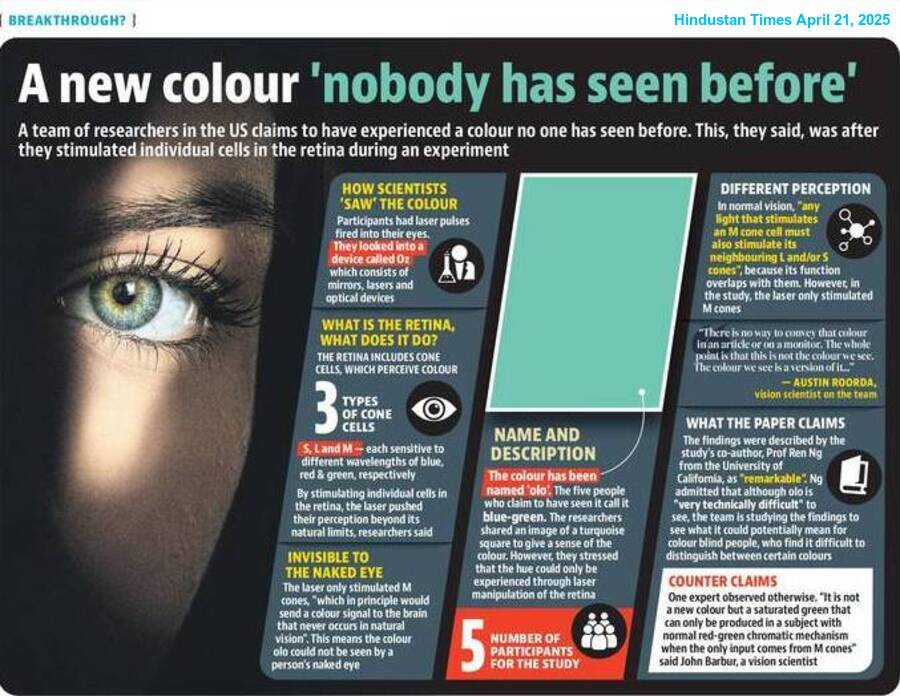
Meanwhile, scientists consider the experiment as a proof-of-concept that human eyes can be programmed to see colours beyond natural limits. They believe that the development would open up new possibilities in vision science, displays and immersive media. Although only five people have seen Olo so far, it is just the beginning.
Boundless Ocean of Politics on Facebook
Boundless Ocean of Politics on Twitter
Boundless Ocean of Politics on Linkedin
Contact us: kousdas@gmail.com

 ISMC
ISMC Boundless Ocean Of Politics