

Microcontinent Discovered In Northern Hemisphere
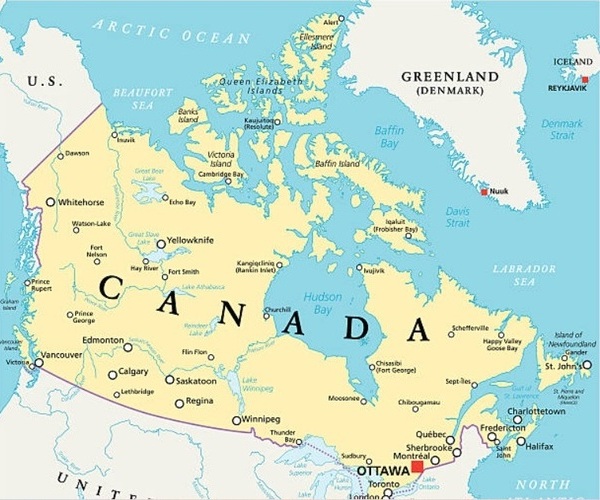
There is a vast ocean on one side, and a bay on the other. Geologists have discovered a microcontinent at the junction of the two huge water bodies! They believe that the Davis Strait proto-microcontinent, hidden beneath the ice sheets, was formed between 49 and 58 million years ago. It may be noted that Davis Strait, situated between Greenland and Canada, connects the Labrador Sea and Baffin Bay. Precisely, the strait acts as a link between these two bodies of water, serving as part of the Northwest Passage and connecting the Atlantic and Arctic Oceans. The complex geological features of this particular region have long been a source of curiosity for scientists.
A team of geologists from Sweden’s Uppsala University and the University of Derby in the UK recently identified a detached layer of thick continental crust in the Davis Strait. The 19-24km thick continental crust, identified offshore West Greenland, was formed by a phase of east-west extension along the edge of Greenland. This extension resulted in the separation of the Davis Strait proto-microcontinent. The recently-discovered submerged continental crust between Greenland and Canada sheds light on the formation of the North Atlantic continent through complex movements of tectonic plates.
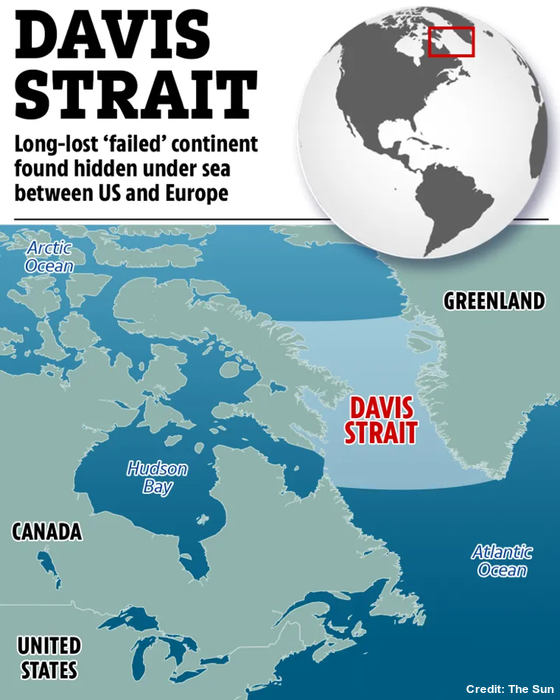
Scientists from Britain and Sweden discovered the proto-microcontinent using gravitational data collected from satellites and seismic readings from ships. Gravitational data helps understand the density of rocks deep below the seafloor, while small changes in the ocean depths are observed due to the gravitational force. On the other hand, seismic data utilises the reflection of sound waves (acoustic waves) to map subsurface structures and to identify changes in deep rock layers. Geologists created different types of computer models with the help of modern technology in order to observe the crust of the Davis Strait.
The British and Swedish researchers have come to know that Greenland and North America began to separate approximately 120 million years ago. The separation accelerated around 61 million years ago as seafloor spreading in the Davis Strait increased the distance between them. Later, the seafloor in the Davis Strait began to spread further, creating a huge gap between present-day Canada and Greenland.
Scientists are of the opinion that the rift between Greenland and North America, and spreading of the seafloor triggered the formation of the proto-microcontinent. A significant phase of east-west extension along the edge of Greenland led to the isolation of the incompletely rifted continental block. The extension, occurring along the margin of West Greenland, also resulted in the separation of this continental fragment from Greenland, potentially driven by transpression and a change in spreading orientation. According to geologists, the movement of Greenland was seemingly guided by the Pre-Ungava Transform Margin, a fault system similar to the San Andreas Fault. About 56 million years ago, Greenland’s path (or the path of movements of tectonic plates) shifted northward, leading to the formation of the Davis Strait proto-microcontinent.
Currently, the proto-microcontinent is in a stable state as researchers have observed no major earthquakes or minimal plate movement in this region. The breakup of the North American plate, leading to the formation of the Atlantic Ocean, happened roughly 150 to 80 million years ago. Later, this rifting stopped and the formation of the Ungava Fault Zone acted as a transform boundary instead. The shift in plate tectonics effectively halted the breakup process in the Davis Strait. Researchers have explained that the collision of Greenland’s crust with Ellesmere Island around 33 million years ago marked a significant tectonic event that likely slowed down the movement of the North American tectonic plate in that particular region. The collision also resulted in the formation of the Davis Strait proto-microcontinent, effectively halting the ongoing rifting (or spreading) of the Davis Strait.

Similar geological structures have been found in other places across the globe. One can mention the Jan Mayen Microcontinent in northeast of Iceland, the East Tasman Rise in southeast of Tasmania, and the Drake Passage that connects the Atlantic and Pacific Oceans near Antarctica. Geologists have opined that the Davis Strait proto-microcontinent has become an ideal natural laboratory for carrying out research on this particular type of continental formation.
Boundless Ocean of Politics on Facebook
Boundless Ocean of Politics on Twitter
Boundless Ocean of Politics on Linkedin
Contact us: kousdas@gmail.com

 ISMC
ISMC Boundless Ocean Of Politics