

Pure Intelligence, Not Artificial
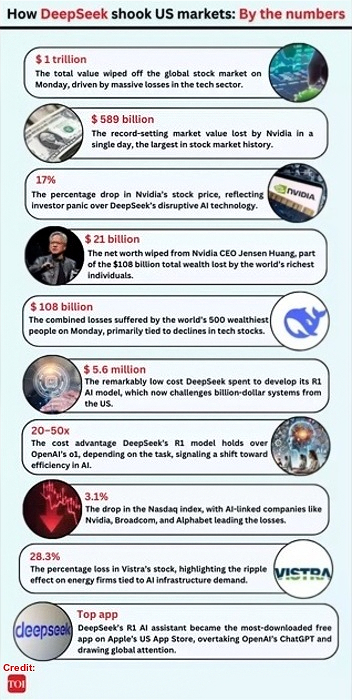
A tremor in the Artificial Intelligence (AI) trading market was felt across the globe on January 27, 2025. DeepSeek, a Chinese startup that recently unveiled a revolutionary AI model, wiped off USD 1 trillion from the Nasdaq’s market value, sending shockwaves through the Wall Street. This is the biggest fall of the US Stock Market in a single day that also disrupted the global markets. The US companies that have dominated the AI market so far are OpenAI, Meta, Google and, of course, Nvidia (in terms of AI hardware). Compared to them, DeepSeek, which debuted in May 2023, was insignificant (in terms of market capital or size).
For a long time, people have thought that building language processing models, like ChatGPT, from scratch would require a huge amount of identified data, as well as computing power. Also, there is a need for a Graphics Processing Unit (GPU), data centres and vast amounts of electricity for AI. It was also thought that not many countries had the ability to bear the huge expenditure for such an innovation, except the US. Analysts assumed that nuclear power, which could provide clean and freely expandable electricity, would gradually become the driving force behind the AI revolution. However, DeepSeek changed the entire equation on January 27 (2025). A startup, with a budget of just USD 6 million, used its extraordinary innovative power to compensate for limited fundings. It seems that the strength of DeepSeek is not based on AI, but purely on human intelligence.
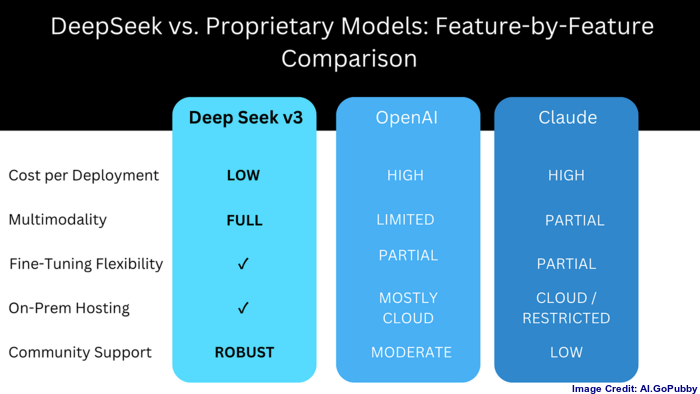
In the world of AI, a token is the smallest unit of language that is used by a larger language model, like ChatGPT, to answer users’ queries. It can usually be a word, partial word or a symbol (such as punctuation mark). Running an AI model, like OPenAI’s ChatGPT-4, costs USD 100 per million tokens. However, DeepSeek costs only USD 4 per million tokens! Most importantly, the impact of DeepSeek innovation is not only limited to the technology sector.
Nvidia, whose AI model was unimaginable without GPU, has suffered a major setback in the stock market. Vistra and Constellation, which bet on the future of nuclear power, have registered a record fall in their share prices. Vertiv Holdings, which provides data centre infrastructure for AI, has also recorded a 30% fall in its share price in recent times. However, it is not just about the fall in share prices, but about ending the monopoly of big tech companies over the most advanced private AI models. It has become important to bring these models within reach of researchers in Developing Nations. In other words, the democratisation of AI is required in the 21st Century world and it could be possible only by creating almost open source (or free to use) models. Many believe that it is the real significance of DeepSeek.
In order to understand the secret behind DeepSeek’s capabilities, one needs to look at a special branch of Machine Learning, formally known as Reinforcement Learning. This is basically a method of learning in which an agent (e.g., a child) directly performs tasks in her/his own environment, realises the outcome of her/his performance (good or bad) and also learns what to do in a similar environment in the future. When one does something well, the person gets a reward. And, when the person does something wrong, s/he gets punished or receives negative feedback, which motivates her/him to do the right thing next time.
When a child learns a new language, s/he does not keep a dictionary with her/him. Instead, the child chooses some of the sounds s/he has heard. If the child repeatedly mispronounces a word, her/his parents teach the child the correct pronunciation. This is a sort of correction or punishment. When the child pronounces the word correctly, everyone showers praises on her/him. It is a reward that encourages the child to pronounce the word correctly next time. The child realises that if s/he correctly pronounces a word, then s/he would get a positive response. And if s/he makes a mistake, then s/he would be corrected. This way, the child gradually learns a language. This process is called Reinforcement Learning.
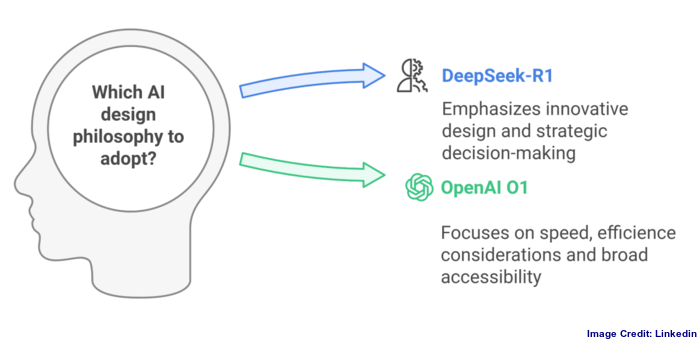
DeepSesk R-1 is one such model that constantly reevaluates its own logic while solving complex problems, learns from the gaps in that logic and gradually becomes stronger, as well as reliable. In terms of machine learning, DeepSeek has given significantly more importance to direct Reinforcement Learning rather than the conventional supervised fine-tuning.
In traditional Reinforcement Learning, an AI model usually pre-determines a reward for correct answers and a punishment for incorrect answers. However, DeepSeek uses a special Reinforcement Learning Method that is similar to the process through which a person develops a new skill. In this case, one makes improvement through the trial and error method. In this particular learning method, if a complex question is asked in different manners or if there are many possible answers to the same question, then the AI model compares different answers it gives at different times. It makes future answers more reasonable without disrupting the stability of the model.
Researchers faced a tough challenge while preparing the DeepSeek model. The US Government imposed strict restrictions on the export of Nvidia chips, making it virtually impossible for China to obtain advanced processing equipment. DeepSeek researchers concentrated on the Mixture of Experts technology in order to overcome the inadequacy of GPUs. The Mixture of Experts technology helps researchers to keep only the predefined expert or special parts active, instead of running calculations for different parts of the large model all the time.
Keeping in mind researchers who cannot afford to buy GPUs worth billions of US Dollars, DeepSeek has launched smaller distilled versions of them. In smaller versions of GPU, a larger model (teacher) trains a smaller model (student). The distilled versions of GPU, with just 48GB of Random Access Memory (RAM), can be run on laptops. In other words, DeepSeek has made advanced AI more accessible to common people. Hence, analysts have compared the success of DeepSeek to the moment when the erstwhile Soviet Union launched Sputnik, calling it the Sputnik Moment! China has made clear that success would no longer be achieved with money or computing power alone in the world of AI, but with unique innovative capabilities and the courage to break conventional methods.
Boundless Ocean of Politics on Facebook
Boundless Ocean of Politics on Twitter
Boundless Ocean of Politics on Linkedin
Contact: kousdas@gmail.com

 ISMC
ISMC Boundless Ocean Of Politics