

The Phenomenon Of Populism
The global community experienced the triumph of Democracy all over the world after the end of ideological struggle between the US and the erstwhile Soviet Union in the 20th Century. European scholars had predicted a different future of the world in the first quarter of 1989. However, the fall of the Berlin Wall later that year proved them wrong, triggering the end of the Cold War. Gradually, the process of democratisation began in Eastern European countries after 1989. While only 36 countries had adopted the Electoral Democratic System in 1974, the number increased to 99 in 1992 and to 118 in 2014.
American Political Scientist Samuel Phillips Huntington (April 18, 1927 – December 24, 2008) described this democratisation process as the Third Wave of Modern Democracy. It may be noted that he described three waves of Democracy: the first slow wave of the 19th Century, a second wave after the Second World War, and a third wave beginning in the mid-1970s in southern Europe, followed by Latin America and Asia.
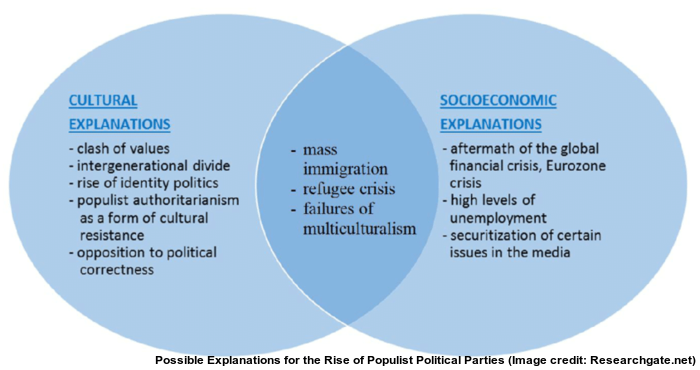
Interestingly, political scientists identified the rise of Illiberal Democracy in the late 1990s and early 2000s. They explained that although those countries held free and fair elections, undemocratic leaders won those polls. As these leaders destroy the basic ideals of Democracy, Liberal Democracy (based on the Constitution) faces a serious threat. Some of these leaders are Populist, like former US President Donald John Trump.
Populist leaders often project a section of people as the public enemy based on race, religion, caste, class or geographical location, inciting division in society. According to Dutch Political Scientist Cas Mudde, the term populist refers to leaders who oppose settlement and divide the members of a society into pure masses and corrupt elites.
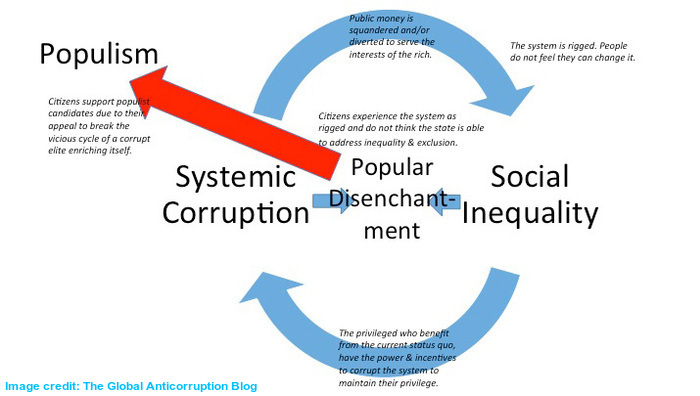
Populist leaders usually present themselves as the real friends of their countrymen, and also project their rival politicians as national enemies. They further use the State Power to suppress their opponents. Ultra-nationalist populist leaders even present race or religion-based minority groups, migrants and pro-establishment politicians as public enemies. Harvard Political Scientists Steven Levitsky and Daniel Ziblatt are of the opinion that the Democratic System has now become the breeding ground of Authoritarianism. They believe that populist leaders use the democratic system only to grab power, and then gradually destroy democratic values, ideals and institutions. Hence, populist leaders are democratically elected undemocratic leaders who pose a serious threat to Liberal Democracy.
According to the Tony Blair Institute for Global Change, 11 populist leaders were in power in different parts of the globe in January 2023. In other words, nearly 1.7 billion people of the global population are still living under the rule of populist leaders. There were 13 populist leaders in the world in 2022. The Tony Blair Institute has claimed that 46 populist leaders or parties came to power after winning elections in 33 countries from 1990 to 2018. Although 11 populist leaders are in power in the world today, some such leaders, including Trump, former Brazilian President Jair Messias Bolsonaro, former President of the Philippines Rodrigo Roa Duterte and former Prime Minister of Slovenia Janez Janša, recently lost elections. According to Tony Blair Institute, Giorgia Meloni (Italy), Benjamin Netanyahu (Israel), Narendra Modi (India), Recep Tayyip Erdoğan (Turkey), Viktor Orbán (Hungary), Andrej Babiš (Czech Republic), Jarosław Kaczyński (Poland), Mateusz Morawiecki (Poland), Viktor Yanukovych (Ukraine) and Nicolás Maduro (Venezuela) are still enjoying power.

Mudde has broadly divided populist leaders into three categories: Right-wing, Left-wing and Anti-establishment. According to the Dutch Political Scientist, Right-wing populist leaders are ultra-nationalist and conservative in nature. They view the nation-state in a negative manner. They also consider migrants and minorities (on the basis of race, religion and culture) outsiders, and threats to the national economy. When Right-wing populism strongly opposes multiculturalism, it is called cultural populism. They not only present the natives as the True People, but also incite them against religious minorities and migrants. Majority of the populist leaders are Right-wing populist, and notable among them are Giorgia Meloni (Italy), Benjamin Netanyahu (Israel), Recep Tayyip Erdoğan (Turkey), Viktor Orbán (Hungary), Jarosław Kaczyński (Poland), Mateusz Morawiecki (Poland), Viktor Yanukovych (Ukraine) and Gotabaya Rajapaksa (Sri Lanka).
On the other hand, Left-wing populist leaders mainly present the Working Class people as the True People. At the same time, they project the capitalists, big business leaders and international financial institutions (the IMF) as outsiders and enemies of people. Nicolás Maduro (Venezuela) is a fine example of a Left-wing populist leader.

Meanwhile, Anti-establishment populist leaders are against the prevailing system in the society. They divide society only into two parts, where the established elite class is seen as the enemy of the True People. Such populist leaders are Andrej Babiš (Czech Republic) and Janez Janša (Slovenia). It is difficult to predict when the contemporary world shall get rid of the populist leaders.
Boundless Ocean of Politics on Facebook
Boundless Ocean of Politics on Twitter
Boundless Ocean of Politics on Linkedin
Contact: kousdas@gmail.com

 ISMC
ISMC Boundless Ocean Of Politics