

Hanging Coffins: The Ancient Funeral Rite
Sagada, a small town near the Cordillera Mountains in Mountain Province of the Philippines, has been a tourist attraction for many years. The town is shrouded in mystery, as one can find coffins hanging high on cliffs in Echo Valley of Sagada.
It is believed that when people died in Sagada in ancient times, their family members placed the body in a wooden coffin and hung it on a cliff. However, most of the people of Sagada still do not know why their ancestors did that. There are many speculations and conjectures about the origin of this custom. Most of the people living in this town were part of ethnic minorities, and it is believed that hanging coffins is one of the funerary practices among the Kankanaey people. They used to live in an area adjacent to the Matangba River before settling in Sagada. The custom is believed to have originated with the inhabitants of the river bank area. Perhaps, they had adopted this particular method in order to protect the graves from ferocious beasts.

Echo Valley’s hanging coffins are displayed high on cliffs, while centuries-old coffins are stacked in burial sites, like Lumiang Cave. Interestingly, the nearby Sumaguing Cave has unusual limestone formations.
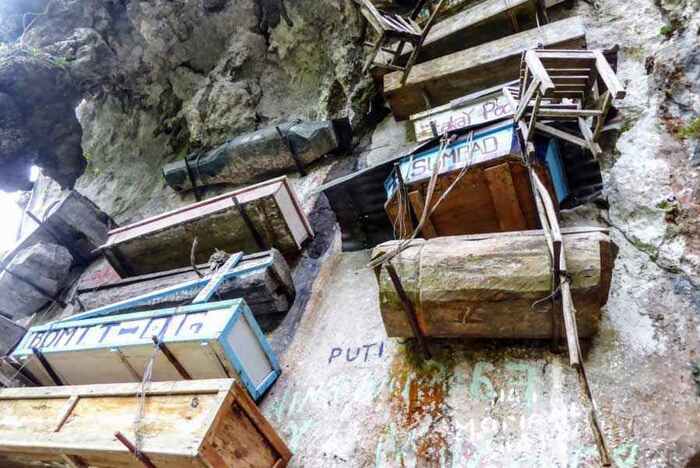
People in some parts of China used to practice the same method of funeral rites in the past. Some historians believe that people of Sagada started following the Chinese tradition in the 8th Century. According to local legends, the coffins were hung on the cliff to facilitate easy passage to heaven. The ancestors of Sagada people believed that the deceased persons could use the hanging coffins as the stairway to heaven. Hence, they hung the coffins from the cliffs with hollow tree trunks. Researchers have found that some coffins were tied with firm ropes.

Some of the coffins hanging from the cliffs in Sagada are tied with wooden chairs! It is believed that these chairs are Sangadil or Death Chairs. Historians discovered about 130 hanging coffins in front of a 330ft-high cliff in 2015. Some of these coffins are more than 1,200 years old. Historians also discovered some coffins from the caves high up on the hill, as those were firmly stuck to the floor (of the caves). Historians are yet to know as to how the coffins were lifted to such a high mountain in ancient times.
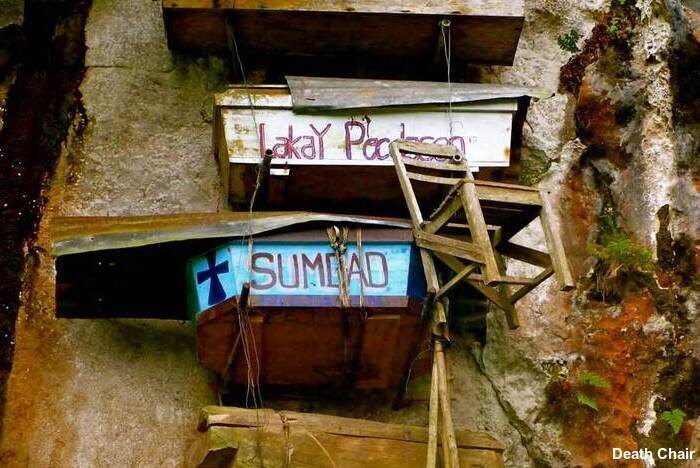
Many think that water could rot the dead bodies, if the coffins were kept beneath the ground. Hence, the ancient people decided to hang the coffins so that the bodies would remain intact for a long time. The coffins hanging on the hills of Sagada vary in size and shape. Historians are of the opinion that the relatively small coffins were made to keep the bodies of children. Tourists from different parts of the globe visit Sagada every year to see the hanging coffins. Some even collect bones from those coffins as souvenirs.

Meanwhile, this strange tradition of hanging the coffins is now believed to have disappeared. A section of historians has opined that the Army of the Ming Dynasty (an imperial dynasty of China, ruling from 1368 to 1644 following the collapse of the Mongol-led Yuan Dynasty) brutally massacred the people of Sagada. After the massacre, the custom disappeared. However, a few Kankanaey people were found in Sagada until 2005.
Boundless Ocean of Politics on Facebook
Boundless Ocean of Politics on Twitter
Boundless Ocean of Politics on Linkedin
Contact: kousdas@gmail.com

 ISMC
ISMC Boundless Ocean Of Politics