

Stone Age Etched In Stone
Someone painted whales, while others created huge and bulky elephants. Viewers may also find turtles, trees and different geometric figures! Interestingly, the creators didn’t use brush and colours, as all the art works were created on stones. But, who created those and when?
Archaeologists are of the opinion that they may be the oldest petroglyphs ever found, possibly dating back to the year 10,000 BC. According to a team of archaeologists led by Sudhir Risbood and Manoj Marathe, the prehistoric rock carvings – discovered recently in western Indian province of Maharashtra – could be evidence of a previously unknown civilisation that possibly thrived tens of thousands of years ago when the people still did not learn to cultivate and the economy was based on hunting and gathering.
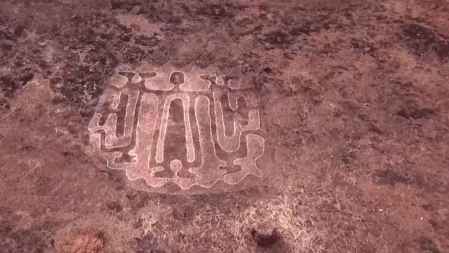
May be the oldest petroglyphs ever found
The archaeologists have found more than 400 such carvings or petroglyphs, including pictures of animals native to Africa, hidden beneath the soil across 52 villages in the Konkan region of western Maharashtra. Risbood and Marathe initially identified 10 new sites, home to 86 petroglyphs.
But how could they lie unnoticed for several years?
“We walked thousands of kilometres. People started sending photographs to us and we even enlisted schools in our efforts to find them. We made students ask their grandparents and other village elders if they knew about any other engravings. This provided us with a lot of valuable information,” stressed Risbood. And the team has discovered the presence of mysterious prehistoric civilisation in 47 villages in that particular area.
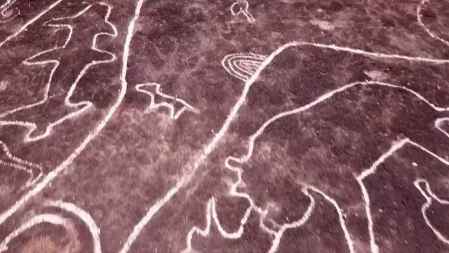
The images are filled with drawings of animals
Now, it’s time to analyse those art works. The government of Maharashtra has already sanctioned USD 3.2 million for saving and proper monitoring of the petroglyphs found inside caves in Ratnagiri and Rajapura.
Speaking at a media conference in Mumbai, Director of the Maharashtra State Archaeology Department Tejas Garge said: “We have not found any pictures of farming activities. But the images depict hunted animals and there’s detailing of animal forms. So, this man knew about animals and sea creatures. That indicates he was dependent on hunting for food.”
Dr Shrikant Pradhan, a researcher and art historian at Pune’s Deccan College who has studied the petroglyphs closely, has expressed similar views. For his part, senior researcher with Pune’s Deccan College of Archaeology Sachin Joshi said: “Judging by the crudity, they seem to have been made in the Neolithic era.”

Meanwhile, the most important question is: why some of the petroglyphs depict animals, like hippos and rhinoceroses, which aren’t found in this part of India. Experts still have no idea how they would have come in contact with these animals while living in India! There is also a possibility that the people, who created them, had migrated to India from Africa… Or else, these animals once were found in India!
Perhaps, the archaeologists will find suitable answers soon……
Boundless Ocean of Politics on Facebook: https://www.facebook.com/boundlessoceanofpolitics/
Boundless Ocean of Politics on Google Plus:
https://plus.google.com/+KoushikDasboundless
Boundless Ocean of Politics on Twitter:
https://twitter.com/kousdas?s=09
Boundless Ocean of Politics on Linkedin:
https://www.linkedin.com/company/boundless-ocean-of-politics
Contact us: kousdas@gmail.com

 ISMC
ISMC Boundless Ocean Of Politics