

Blow Hot Blow Cold: Words & War
UN Secretary General António Guterres has expressed serious concern about the Russia-US relationship after Moscow gave a fitting response to Washington over the ‘Sergei Skripal’ issue. The former prime minister of Portugal warned that relations between the two powers recently deteriorated to an extent comparable “to what we lived during the Cold War”.
Russia’s ties with the West are going through a rough patch because of the Skripal case. On March 26, US President Donald Trump expelled 60 Russian diplomats in wake of UK nerve agent attack. The president also ordered the closure of a Russian consulate in Seattle. Later, the European Union nations, Canada and Ukraine expelled another 100 Russian diplomats in response to Moscow’s alleged use of a nerve agent to poison the former Russian spy living in the UK. As a tit-for-tat retaliation against the co-ordinated wave of expulsions of Russian diplomats ordered by the West, Moscow gave marching orders to 59 diplomats from 23 countries on March 30 and also asked London to trim the British contingent to same size as Russia has in the UK.
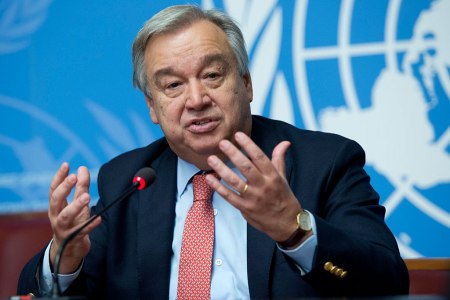
UN chief António Guterres
The Kremlin also decided to expel the same number of American diplomats from Russia and informed the US envoy to Moscow about its decision. The Russian officials told US Ambassador Jon Huntsman that the American Embassy in St Petersburg would be closed soon. After the meeting between top Russian officials and the American diplomat, Washington issued a statement, saying that Moscow’s decision would have a great impact on bilateral ties. “We reserve the right to respond,” it added. Meanwhile, Russian Foreign Minister Sergey Lavrov stressed that the West prompted Kremlin to take the bold step. (Perhaps) it’s the first time since the Cold War when Moscow and Washington have got engaged in such a serious diplomatic conflict.
The problem began in the first week of March when the former double agent, Skripal, and his daughter Yulia were found poisoned in Salisbury with a military-grade nerve agent, Novichok. The British government claimed that Novichok was developed in Moscow, with Prime Minister Theresa May saying that Russia was behind the attack, a charge denied by Moscow. However, the May administration expelled 23 Russian diplomats from London. Although Moscow, too, expelled 23 British diplomats, 20 European countries backed London’s decision and took disciplinary measures against Russia.
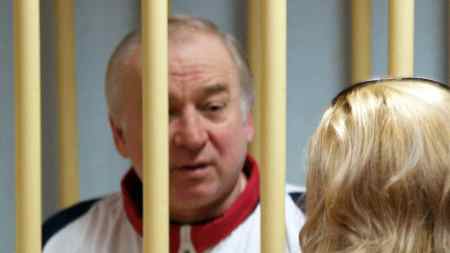
Sergei Skripal
As expected, the diplomatic war between Russia and Britain has started influencing the Moscow-Washington relationships. Foreign policy analysts are of the opinion that Russia and the US are heading towards ‘another’ Cold War era. Defence experts, too, have expressed a similar view, saying that Russia and China are catching up with military power of the US and the West. In its ‘Military Balance 2018’ report, the International Institute of Strategic Studies (IISS) has clearly mentioned that Moscow and Beijing are challenging the military supremacy of the US and its Western allies. According to the London-based research institute in the area of international affairs, the West should not rely on the strategic advantage enjoyed by it until now. The leading think tank further stated in its annual report that although a war between the great powers was not inevitable, Russia, China and the US started making systematic preparations for the possibility of a conflict.
According to the report, China plans to acquire and expand its formidable arsenal. With the Chengdu J-20 combat aircraft entering service in China in 2020, the US is all set to lose its monopoly on stealth aircraft. The Asian powerhouse has also decided to extend the range of its PL-15 air-to-air missile system by equipping missiles with electronically scanned radars. As far as the modernisation of its Armed Forces is concerned, China has built more corvettes, destroyers, frigates and submarines than Japan, India and South Korea combined.

The Chinese & Russian presidents
However, the pace of militarisation is comparatively slower in Russia mainly because of funding and industrial issues. At the same time, we have to remember the fact that Russia is hugely benefiting from experience of real life combat in Syria and Ukraine. In recent times, Moscow has shown extensive capabilities in the field of hybrid warfare, including cyber attacks.
Talking to the press over the weekend, Director General and Chief Executive of the IISS Dr John Chipman said: “Some governments in the West will look to ‘leap-ahead’ technologies to augment and even deliver military power, but these are no guarantee of success.” He added: “China’s emerging weapons developments and broader defence-technological progress further its transition from ‘catching up’ with the West to becoming a global defence innovator. The West no longer has a monopoly on world-leading defence innovation and production, or the funds to enable these.”
Boundless Ocean of Politics on Facebook: https://www.facebook.com/boundlessoceanofpolitics/
Boundless Ocean of Politics on Google Plus:
https://plus.google.com/+KoushikDasboundless
Boundless Ocean of Politics on Twitter:
https://twitter.com/kousdas?s=09
Contact us: kousdas@gmail.com

 ISMC
ISMC Boundless Ocean Of Politics
1 Comment »