

Rulers & The Communists
In his important pamphlet ‘The Civil War in France’ (1871), Karl Marx expressed his views on the commune. He wrote: “The Commune, was to be a working, not a parliamentary, body, executive and legislative at the same time…Instead of deciding once in three or six years which member of the ruling class was to represent and repress the people in parliament, universal suffrage was to serve the people constituted in communes, as individual suffrage serves every other employer in the search for workers, foremen and accountants for his business.”
Vladimir Ilyich Lenin, in his ‘State and Revolution’ (August 1917), termed the ‘bourgeois parliamentary system’ as a pigsty. Later, he became the founding father of the world’s first socialist nation. And the ‘Supreme Soviet’ replaced the ‘State Duma’ as the state legislature. There were barracks, district etc. in the Supreme Soviet. They used to send representatives to the Soviet or Council through a single voting. As a result, the Soviet was accountable to their voters and used to follow their instructions. Also, the local Soviets used to send their representatives to the superior Soviets and superior Soviets to the Supreme Soviet.
According to the Russian communists, the representatives would strive to get closer to the people and translate the decision emanating from their genuine needs into a corresponding law, through the single voting system. They thought that the process would ensure the ‘dictatorship of the real proletariat’. Members of the Soviets were not part of the ruling class, but the people. Communists should be like that!
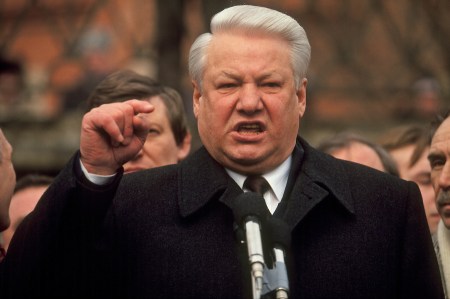
Boris Yeltsin
Boris Yeltsin became the Chairman of the Supreme Soviet in 1990. Next year, he became the President of the ‘Russian Soviet Federative Socialist Republic’. In a few days, the Soviet Union collapsed and the Russian Soviet Socialist Republic became the Russian Federation. However, Yeltsin continued serving as its president. This development raised an important question: who was Yeltsin in actuality? As a member of the Soviet, he should be a part of the proletariat. But, he continued as the president of not-so-communist Russia. Not only Yeltsin, but most of the leaders from the grassroot level (as claimed by the Soviet regime) and representatives remained in power even after the fall of the Soviet Union.
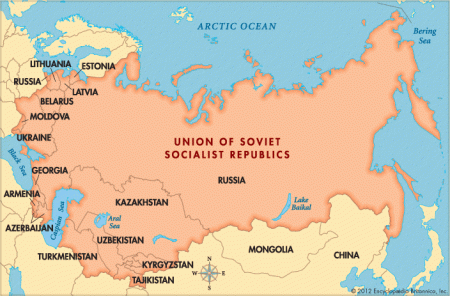
Fifteen states emerged from the Union of Soviet Socialist Republics (USSR) in its breakup in December 1991, with Russia internationally recognised as the successor state to the Soviet Union. Many leaders of the Soviet-era became the rulers of most new states. Islam Abduganiyevich Karimov was one of them. Karimov was the leader of Uzbekistan and its predecessor state – the Uzbek Soviet Socialist Republic – from 1989 until his death in 2016. Another one was Hasan Hasanov Aziz oglu. He served as Azerbaijan’s last communist leader and as the Prime Minister of Azerbaijan – both during the Soviet rule and Azerbaijan’s subsequent independence after the collapse of Soviet Union. Eventually, Hasanov resigned on April 7, 1992. The third one was Anatolijs Gorbunovs. Gorbunovs served as the Chairman of the Supreme Soviet during the final years of the Soviet regime in Latvia and also as Chairman of the Supreme Council of Latvia during the first years after the Baltic nation regained its independence. He also served as the acting head of state before the election of the Fifth Saeima (the Latvian Parliament) in 1993.
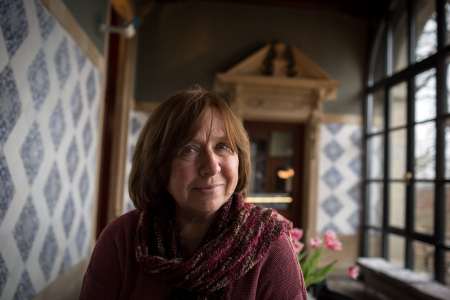
Svetlana Alexandrovna
In her publication ‘Secondhand Time: The Last of the Soviets’ (2013), Svetlana Alexandrovna Alexievich described how Aleksandr Lukashenko was elected President of Belarus after the country declared independence on August 25, 1991 and retained office in 2001, 2006, 2010 and 2015. The winner of Nobel Literature Prize (in 2015) also narrated how Lukashenko had been instrumental in crushing protests that followed the December 19 (2010) Presidential Election. The list goes on….
Those, who were the leaders of Proletariat, became heads of the states that adopted the ‘market economy’. This was possible possibly because the Soviet leaders were not at all ‘communists’. They were rulers!
The political career of the eighth and last leader of the Soviet Union Mikhail Gorbachev was over on December 25, 1991 when he announced his resignation on television, and the USSR collapsed by the end of the year. Gorbachev left Moscow at 7:32pm (on December 25) and the Tzar-era tricolour replaced the red flag in Kremlin. The people might ask what had changed in those 74 years?
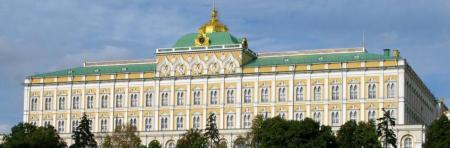
The Grand Kremlin Palace
A ruler is a ruler…..that is the only identity of his character. Lenin had chosen the Tzar’s Palace in Kremlin as his residence. Later, Joseph Stalin replaced the golden eagle at the top of the Palace with bright stars. The current Russian president, too, lives in Kremlin. Once again, the five pairs of eagles have replaced the hammer, sickle and CCCP at the top of the Kremlin Palace.
The Communists have always followed the right path. They fought against the ‘evils’ during the Soviet era and they are fighting, still.
Boundless Ocean of Politics on Facebook: https://www.facebook.com/boundlessoceanofpolitics/
Boundless Ocean of Politics on Google Plus:
https://plus.google.com/+KoushikDasboundless
Boundless Ocean of Politics on Twitter:
https://twitter.com/kousdas?s=09
Contact us: kousdas@gmail.com

 ISMC
ISMC Boundless Ocean Of Politics