

Russia Wants India To Take Part In OBOR
Russia, popularly known as New Delhi’s ‘old friend’, tries hard to help India and China ‘normalise’ ties.
Kremlin recently requested India to join China’s ‘One Belt One Road’ (OBOR) initiative, with Foreign Minister Sergey Lavrov saying that the proposed move would certainly help the South Asian nation boost economic growth. Speaking at an event in the Indian capital last week, the visiting minister said that India should utilise the mega connectivity project in order to ensure growth “without even sacrificing its position on the issues flagged by it”.
Lavrov told the audience that the global community (read China) knows it would be impossible to create a sustainable security architecture in the Asia Pacific region without India’s ‘active’ participation. He stressed that the architecture should be achieved through “bloc arrangement”.
With this statement, the Russian minister made clear that Moscow would never accept the activities of quadrilateral grouping – comprising the US, Japan, India and Australia – in this particular region.
After attending the 15th Russia-India-China (RIC) trilateral meeting in New Delhi, Lavrov and his Chinese counterpart Wang Yi met Indian External Affairs Minister Sushma Swaraj to discuss various important trilateral, regional and global issues. Lavrov told Swaraj that India should normalise ties not only with China, but also with ‘arch-rival’ Pakistan to ensure regional peace and stability.
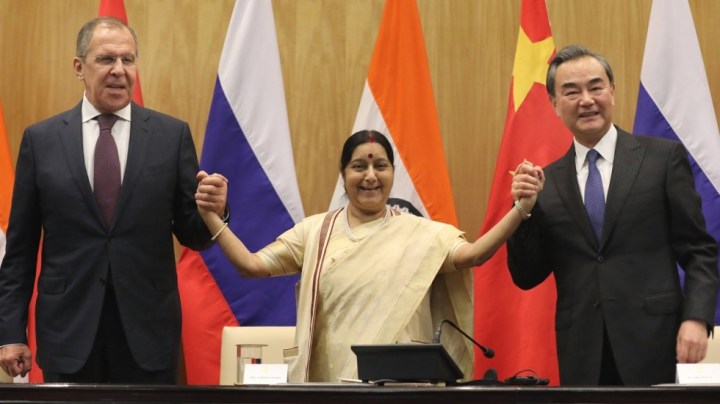
Lavrov, Swaraj & Wang
As far as the Chinese OBOR initiative is concerned, the Russian minister said that Moscow appreciated the concept, as it brought an opportunity for countries in the region to explore ways to build harmonious relationship for deeper regional trade and investment. Commenting on India’s opposition to the project, he stressed: “The specific problem in this regard should not make everything else conditional for resolving political differences.” India is against the OBOR because of its sovereignty concerns over the USD 50 billion China-Pakistan Economic Corridor (CPEC) that passes through Pakistan-occupied-Kashmir (PoK). India is against the initiative as CPEC is part of the OBOR.
Lavrov told Swaraj that almost all the Central Asian countries signed accords with China and they wanted Beijing to implement the OBOR project as soon as possible. According to the visiting minister, Russia and other member states of the Eurasian Economic Union have joined hands with China for the betterment of Asia.
Later, he told the media: “I am 100% convinced that India has enough very smart diplomats and politicians to find a way which will allow it to benefit from this process and at the same time not to sacrifice your position.”

However, India has no immediate plan to join the Chinese project. A senior official of the Indian Ministry of External Affairs hinted that the quadrilateral grouping among the US, India, Japan and Australia was ready to create a different sustainable security architecture in the Asia-Pacific to counter China’s growing influence.
During their first meeting in Manila in November, officials of the four countries decided to keep the ‘Indo-Pacific’ (and not the Asia-Pacific) region “free and open”. They claimed that the bloc was formed mainly to contain China’s growing assertiveness in the resource-rich area. At the same time, the Indian official urged Russia not to influence New Delhi’s ‘China policy’, saying that Moscow would always remain the South Asian country’s key partner irrespective of its close ties with the Asian giant.
Boundless Ocean of Politics on Facebook: https://www.facebook.com/boundlessoceanofpolitics/
Boundless Ocean of Politics on Google Plus:
https://plus.google.com/+KoushikDasboundless
Boundless Ocean of Politics on Twitter:
https://twitter.com/kousdas?s=09
Contact us: kousdas@gmail.com

 ISMC
ISMC Boundless Ocean Of Politics