

Centenary Of Bolshevik Revolution: The London Connection
There is a small memorial in front of a house in Islington, north London. It is written on the memorial that founder of the USSR Vladimir Ilyich Ulyanov – better known by the alias Lenin – lived here in 1908. While being in exile in London in 1902-03, Lenin’s address was 30 Holford Square, Finsbury. He used to stay here with his wife Nadezhda Krupskaya. Today, the house is not there as it was badly damaged during the WWII. In 1942, Russian architect Berthold Lubetkin built a statue of Lenin in front of the house.
After the war, Lubetkin was asked to build an apartment block in that area. It was called ‘Lenin Court’. During the construction of the block, the statue was temporarily shifted to a nearby garden. Communists from different countries used to visit the place. Sometimes, anti-communists made attempts to damage the statue. When Lubetkin completed the construction work (in the early 1950s), the world was going through a Cold War. Then, the British government changed the name of the apartment and called it ‘Bevin Court’ in order to pay respect to former British Foreign Secretary Ernest Bevin.
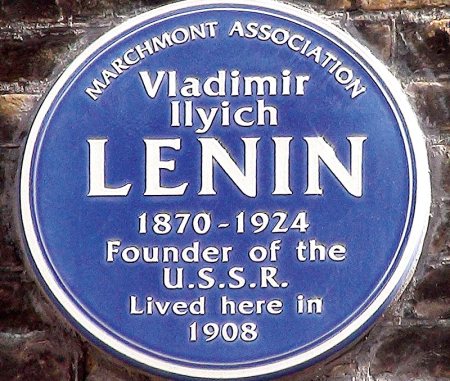
Tavistok
There is another story behind Lenin’s memorial and also behind the name of the apartment block. The story is about how libraries and auditoriums in London held the ideology of the Great Russian Revolution in the late nineteenth and early twentieth century.
Lenin and Krupskaya had to leave Russia in the early twentieth century. To avoid Tsar’s police, they took shelter first in Geneva and then in Munich. The couple arrived in London in April 1902 from Munich. At that time, Lenin’s main aim was to continue to publish ‘Iskra’ – the mouthpiece of Russian Social Democratic Labour Party (RSDLP). The journal was crucial both for building up a network of revolutionary activists and also for spreading the political analysis he favoured. Upon his arrival in England, Lenin met his friend Nikolai Alexeyev at Charing Cross railway station. Alexeyev, a political emigrant living in London, took the couple to 30 Hallsford Square.
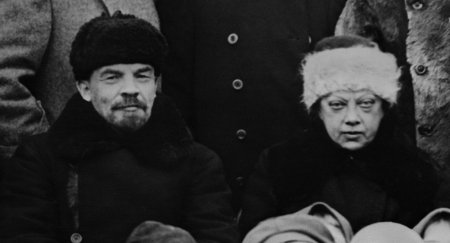
Lenin & Nadezhda Krupskaya
During his stay in this house, Lenin sought permission from the British Museum Library to use its books. In April 1902, he used the name of ‘Jacob Richter’ to apply for a ‘reader’s ticket’. In the application, Lenin wrote that he came from Russia to study land related issues. In fact, the British Museum Library accepted his application on April 29 and sent a ticket (number A72453) to him. Lenin’s hand-written application is still there in the British Library. Lenin and his wife spent just over a year in that Holford Square house and upset the bourgeois landlady Mrs Emma Yeo with their bohemian behaviour.
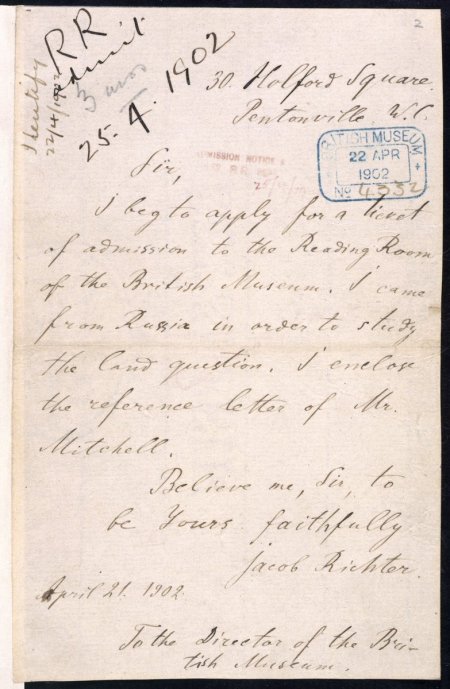
Lenin’s application
At first, the couple faced some difficulties in London due to their inability to speak fluent English. Although Lenin and Krupskaya had translated Beatrice and Sidney Webb’s ‘Industrial Democracy’ whilst in Siberia, they lacked real experience of spoken English.
Lenin used to spend the mornings working at the Reading Room of the British Museum. Later, Krupskaya recalled that her revolutionary husband was highly impressed with ‘the world’s richest library’. However, he didn’t like the museum. On his way back to home in the evenings, Lenin conducted Iskra business at 37A Clerkenwell Green (now the Marx Memorial Library).

Lenin’s room in Marx Memorial Library and Iskra
Iskra means ‘spark’ in English. The Ulyanov family knew that every revolution begins with a spark. One day, Lev Davidovich Bronstein – a Ukrainian revolutionary – joined them in London after spending some years in Siberia. He knocked Lenin’s door one fine morning. Krupskaya opened the door and told the ‘stranger’ that Lenin was in his bed and he would have to wait. However, Lev was in a hurry. The future will recognise this stranger as Leon Trotsky.

Leon Trotsky
The preparatory work for the Great Revolution actually began in the capital of the British Empire. Strong debates over the way the revolution would take place in Russia took place at the Iskra office in London. Julius Martov and others were of the opinion that the revolutionary party was not enough and everyone should be able to express their views, apart from being loyal to the party. Lenin had a different view, as he argued that the powerful vanguard party could only trigger a revolution and no one was above the party. Later, Iskra’s office was divided. People, like Martov, became Menshevik (or minority), while Lenin and his followers became Bolshevik (or majority).

Marx Memorial Library
Lenin loved to visit different places in London, such as Primrose Hill and Regents Park Zoo. Many of his leisure activities were associated with his work. He regularly attended Speakers’ Corner in Hyde Park to listen to speeches. Krupskaya wrote: “Ilyich studied living London. He liked taking long rides through the town on top of the bus. He liked the busy traffic of that vast commercial city, the quiet squares with their elegant houses wreathed in greenery, where only smart broughams drew up. There were other places too – mean little streets tenanted by London’s work people, with clothes lines stretched across the road and anaemic children playing on the doorsteps. To these places, we used to go on foot. Observing these startling contrasts between wealth and poverty, Ilyich would mutter in English through clenched teeth: “Two nations!”
Lenin went through Karl Marx’s publications in the Reading Room of British Museum. Helen Rappaport, the author of ‘Conspirator: Lenin in Exile’, says that the founding father of USSR lives in the memory of many people in London. Lenin was popularly known as a hardworking person who studied a lot. He always used to read books and used to read very quickly. He wrote ‘One Step Forward, Two Steps Backward’ in London. In this book, Lenin described the ideological differences between the Bolsheviks and the Mensheviks.
From 1902 to 1911, Lenin visited London six times. For him, the city was a symbol of evil which he wanted to eradicate. He used to visit the East End with his friends to witness the class division.
Lenin visited the British capital in 1903, 1905 and 1907 mainly to attend the Congress of RSDLP. He returned to London in May 1908. This time, his address was 21 Tavistock Place. He spent his time preparing materials for writing ‘Materialism and Empirio-Criticism’, which was published the following year. Lenin’s final and brief trip to London was in autumn 1911. He stayed at 6 Oakley Square near Mornington Crescent and delivered a lecture on ‘Stolypin and the Revolution’ at the New King’s Hall, Commercial Road, on November 11.
When Joseph Stalin arrived in London in 1907 to attend the 5th Congress of the RSDLP, he lodged at Tower House, Fieldgate Street, Whitechapel. The rent was just six pence per night. Apart from Stalin, Trotsky, Rosa Luxemburg and (of course) Lenin attended the 5th Congress.

Stalin, Lenin & Trotsky
Many believe that Lenin met Stalin for the first time at the Crown Tavern on Clerkenwell Green during the 1905 Congress. But, this is a myth. According to Russian historians, the two great men first met at the Bolshevik Congress in Finland in December 1905-January 1906. However, Stalin and Trotsky spent times with Lenin at Iskra office. The office was at 37A Clerkenwell Green (now the Marx Memorial Library). From April 1902 to May 1903, Lenin edited and published 17 editions of Iskra from this office. The office – a small, modernist-Edwardian-minimalist room – has been well preserved.
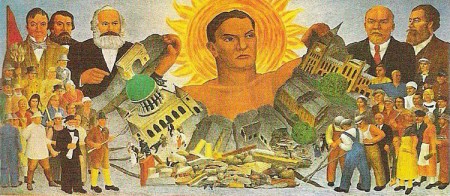
Mural
The library was established in 1933 to mark the 50th death anniversary of Marx, who died in London on March 14, 1883. A famous mural has also been kept in this library. The Earl of Huntingdon or the ‘Red Earl’, a pupil of Diego Rivera, painted this stunning mural, depicting the overthrow of capitalism, on the walls of the Library in 1934, immortalising Lenin, Marx, Owen, Morris and Engels. The title of the mural is beyond parody: ‘The worker of the future clearing away the chaos of capitalism’. In the picture, a muscly Welsh miner tears down the Houses of Parliament, while Lenin looks on approvingly.

Lenin’s statue
So what happened to the statue of Lenin installed outside Holford Square? It secured a place in Islington Museum. What a strange coincidence! Islington is the constituency of Labour Party leader and Leader of Opposition in the British Parliament Jeremy Corbyn.
Even 100 years after the October Revolution, this area is still very relevant as it is considered as ‘the British road to Bolshevism’. This is the area where the communist dream never died.
Boundless Ocean of Politics on Facebook: https://www.facebook.com/boundlessoceanofpolitics/
Boundless Ocean of Politics on Google Plus:
https://plus.google.com/+KoushikDasboundless
Boundless Ocean of Politics on Twitter:
https://twitter.com/kousdas?s=09
Contact us: kousdas@gmail.com

 ISMC
ISMC Boundless Ocean Of Politics