

Mukherjee Clears The ‘Test’ Gracefully
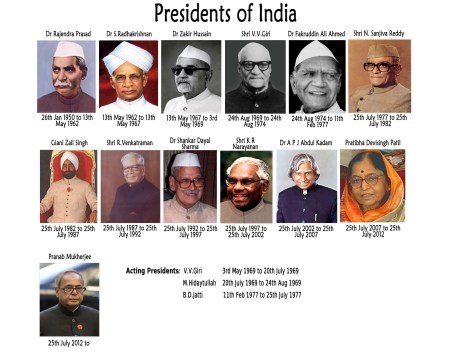
Pranab Mukherjee has a habit of keeping a copy of an Indian Constitution in his handbag wherever he goes. It is not that he started doing so only after becoming the president of India in 2012. It’s an old habit. When Mukherjee entered the Raisina Hill or Rashtrapati Bhavan (the official residence of the President of India) on July 25, 2012, he became the constitutional head of India in the true sense.
After becoming the president, Mukherjee used to miss his “super-active” political life. To get relief, he concentrated on Henry Kissinger’s “White House Years” and also started watching the live coverage of parliamentary sessions on television. Perhaps, he recalled those days when he served as an important member of the Congress Working Committee and the president of the Pradesh Congress Committee in his native state West Bengal. He was not only an important member of Indira Gandhi, Narasimha Rao or Manmohan Singh Cabinets, but also the “Number Two” personality. And when he became the constitutional “Number One” (or the first citizen of India), Mukherjee gradually tried to become a competent president.
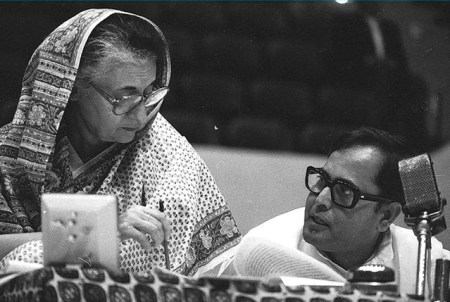
(Indira Gandhi & Pranab Mukherjee)
With a political career spanning over six decades, ‘Dada’ did not follow the path of Gyani Zail Singh, who (as a president) conspired against then Prime Minister Rajiv Gandhi and wanted to overthrow the latter. He was not even like Pratibha Patil, the “opinion-less” president of India. Mukherjee tried to become a “creative” president from within the boundaries of the Constitution. As far as the presidential powers are concerned, we know there is a (wide controversial) grey area in the Indian Constitution. It has been mentioned as “discretionary” power in the Oxford Handbook of Indian Constitution.
With Mukherjee completing five years as the 13th Indian president on July 24 (2017), we can say that he has gracefully cleared the test. His presence at the Raisina Hill was as clear as daylight. Also, there is no evidence that he had conflicts with the Narendra Modi government, despite the fact that Mukherjee had reservations about some decisions made by the Modi administration. In fact, he did not allow any constitutional crisis to happen.
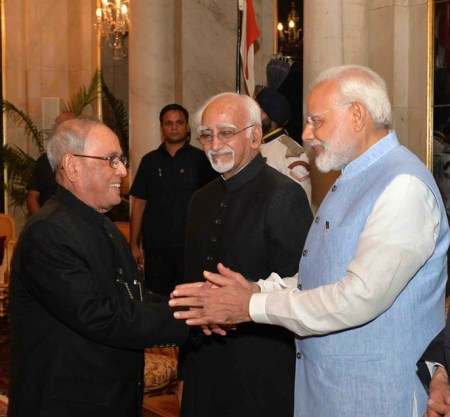
(Pranab Mukherjee & Narendra Modi)
Babu Rajendra Prasad was the only Indian president who served two consecutive terms. And there was a considerable debate about the presidential power between Rajendra Prasad and Jawaharlal Nehru, the first Prime Minister of India. Rajendra Prasad was of the opinion that there was a “life” in presidential powers as described in the Constitution. On the contrary, Nehru used to believe that “the Indian president is powerless”. Rajendra Prasad went on a direct confrontation with Nehru over the Hindu Code Bill and the Abolition of Zamindari Act. But, the PM won the battle against the president with the help of some legal experts. Later, Nehru established his authority in the new Indian structure of parliamentary democracy after winning two General Elections (in 1952 and 1957) and many political scientists and experts started calling it the “Nehruvian Presidency”.
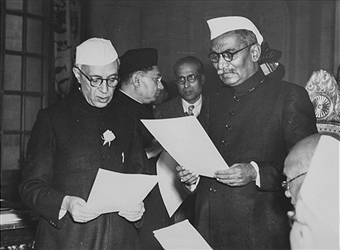
(Jawaharlal Nehru & Rajendra Prasad)
In fact, the Indian Constitution allowed the president to challenge the power of the prime minister. Nehru’s daughter and former Indian Prime Minister Indira Gandhi was well aware of this fact. That’s why she introduced the 42nd and 44th constitutional amendment bills in the Parliament to change the 74th paragraph of the Constitution. Gandhi’s main purpose was to establish the Nehruvian model of Westminster government in India. So, she curtailed the presidential powers.
American political scientist Douglas Verne once said that president is head of the state and prime minister is head of the government. Even, the British Queen can apply her powers, if necessary. In 1885, there was a strong debate about the role of the Queen in the formation of the government in British Parliament. Prime Minister of the minority government Lord Salisbury told Queen Victoria: “You are the sovereign ruler. He, who will please you, will be the PM.” The Queen gave her verdict in favour of Salisbury and made him the PM. She could advise the PM, but there was no minute of meetings between the Queen and PM Salisbury. Also, they did not have any personal secretary. In her autobiography, Margaret Thatcher writes: “Those, who think that the Queen does not have any power, are wrong.” Even in India, there were debates over the role of the president whenever the country was ruled by a ‘minority’ government.
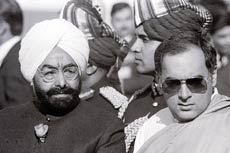
(Gyani Zail Singh & Rajiv Gandhi)
Modi’s unprecedented majority in 2014 Parliamentary Polls protected Mukherjee from all these controversies. In the last four years, President Mukherjee differed with PM Modi on several issues, but those remained secret.
Majority of the people in India has no idea that Mukherjee was against the Army’s decision to use civilians as “human shields” in Kashmir. He believes that the Army’s main task is to stay in borders and protect the country. Mukherjee also believes that Army should not be used in maintaining the law and order situation inside the country. A senior official of the Indian Defence Ministry recently informed an Army officer that President Mukherjee expressed dissatisfaction to the government over the poor handling of situation in Kashmir by the armed forces.
Also, President Mukherjee did not attract media attention by returning files to the government. Of course, he disagreed with the government about several files and tried to change the government’s decision through discussions. He not only opposed the Modi government’s decision to remove the vice chancellor of Delhi University, but also refused to sign ordinances bypassing the Parliament. Mukherjee has been criticised for giving the “president’s approval” in death penalty-related cases. But, the fact is that Cabinet makes the decision of death penalty on the basis of various court rulings. It also involves a long judicial process. And the president cannot ignore the process. Whenever there were legal doubts in death penalty cases (sent to him by the government), Mukherjee sent those back to the Cabinet.
Sometimes, APJ Abdul Kalam returned some files to the government and informed the press about his action through his media advisers in order to establish himself as an “Angry President”. But when the Cabinet sent those files back to him for the second time, Kalam had no other option, but to sign them. Unfortunately, the media did not cover those news. Mukherjee did not want to create the image of “Angry President” (in Kalam’s style) through the media. Also, the “Textbook Man” did not show unquestionable loyalty, like Pratibha Patil, to the ruling party. He only tried to perform his duties from within the constitutional limit.
During the Midnight GST Launch in Parliament on June 30, 2017, Mukherjee did not forget to inform members of the House that he had prepared the draft of the GST Bill during his tenure as the finance minister of India. He also informed the parliamentarians that PM Modi (who was the Chief Minister of Gujarat at that time) had opposed the Bill. The “Chanakya” of modern Indian politics also expressed serious concern over the “political intolerance” experienced by the people of India in recent times.
The president, too, has a reach in the Indian democracy. Mukherjee’s five-year tenure has made it clear that ‘check and balance’ is always necessary in a democratic system. The Congress Party had made a mistake by nominating Pratibha Patil as president during the UPA regime and the BJP committed the same mistake by nominating Ram Nath Kovind as Mukherjee’s successor. If a ‘dalit’ president can ensure the advancement of the backward community, then the dalit issue would have been solved during K R Narayanan’s presidency.

(Rashtrapati Bhavan)
Mukherjee increased the prestige of the presidential post through his talent and vast political experience. In the interest of democracy, preservation of the constitutional status of the Presidential Palace is required.
Boundless Ocean of Politics on Facebook: https://www.facebook.com/boundlessoceanofpolitics/
Boundless Ocean of Politics on Google Plus:
https://plus.google.com/+KoushikDasboundless
Boundless Ocean of Politics on Twitter:
https://twitter.com/kousdas?s=09

 ISMC
ISMC

Thanks for sharing such a nice thought, post is good,
thats why i have read it entirely http://pfamaqa.sms.morris.com/beware-monster-truck-games-scam
LikeLike