

Australia Facing Rising Chinese Aggression
Vantor (formerly Maxar Intelligence), a US-based commercial spatial intelligence technology company, warned Australia about Chinese aggression in the first week of December 2025. The company provided Australia with high-resolution satellite imagery, showing the Chinese naval activities in the Indo-Pacific. Vantor, which tracked Chinese warships in the Philippine Sea, claimed that they advanced recklessly towards northern Australia through the Philippine Sea. The institution also described this sort of Chinese aggression as dangerous for Canberra.
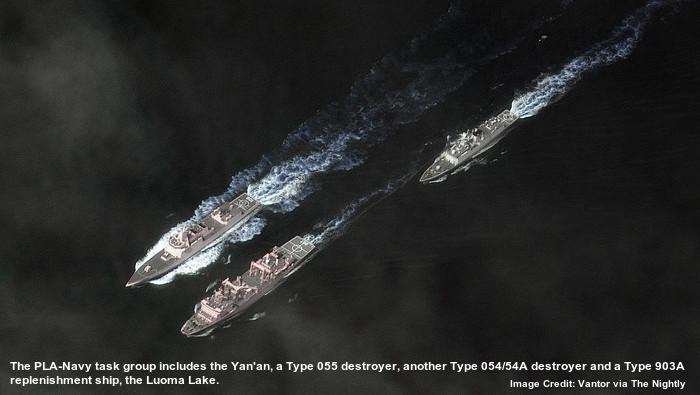
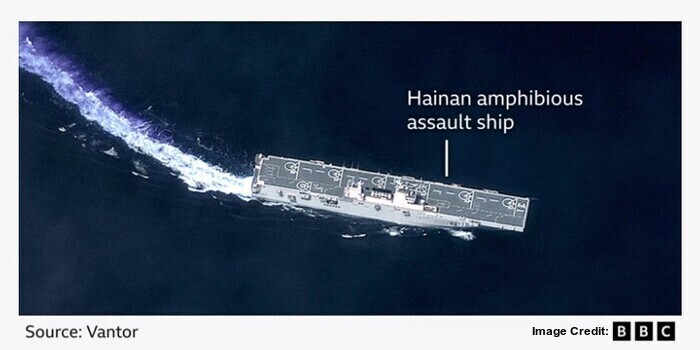
The Western media, too, reported that the Chinese naval fleet, deployed in the Philippine Sea, began to move aggressively towards Australia on December 2. Immediately after receiving images from the spy satellites, Vantor informed Australia that two warships and a vessel, carrying military helicopters, were slowly moving towards the largest country in Oceania. An oil tanker was also accompanying them to meet their fuel needs.
As expected, Australia became alert after receiving the information. Admiral David Johnston, the Chief of the Australian Defence Force (ADF), confirmed that four Chinese naval ships, including a Renhai-class cruiser and a Jiangkai-class frigate, were advancing towards Australia. Upon receiving reports of the presence of Chinese warships in the waters adjacent to Australian territory, Admiral Johnston deployed a RAAF P-8 surveillance aircraft to track the movements of the Chinese vessels. He told the media that the surveillance plane observed the Chinese task group operating in the Philippine Sea on December 2 evening, approximately 500 nautical miles north of Palau. “I have previously stated that we have seen a greater PLA Navy presence in our immediate region in recent years, and we do expect to see future PLA in extended area deployments,” he stressed. Admiral Johnston further said that the ADF would continue to monitor this task group, “as we learn more about its direction, its purpose and an intent”.
For his part, Richard Marles, the Deputy Prime Minister and the Defence Minister of Australia, stated that Canberra was tracking the Chinese Navy flotilla in the Philippines Sea. “We maintain constant maritime domain awareness in our geographic areas of interest. We will routinely monitor the movements of PLA vessels when there are movements such as this. We will monitor them particularly until we know they are not coming in the vicinity of Australia,” he said while speaking at a press conference.
Mike Plunkett, the senior US naval platforms analyst, told BBC that the satellite imagery showed the vessels being replenished at sea. It involved the transfer of fuel, supplies and ammunition from one ship to another. According to the analyst, the image also showed a line running between the cruiser Yan’an and replenishment ship Luoma Hu, while a Jiangkai II-class frigate was getting ready to join the replenishment ship. “All of the above are standard operations for any first-rate Navy and the Chinese have been doing it successfully for many years. The ability to replenish ships at sea means that Navies are not tied to bases and can stay at sea for longer and further away than would otherwise be the case,” added Plunkett.
Meanwhile, the Chinese Foreign Ministry has claimed that the PLA Navy is deployed in the Indo-Pacific Region in accordance with international law and Beijing has no plans to attack any country. However, Reuters has reported that the “Chinese ships have massed in waters stretching from the southern part of the Yellow Sea through the East China Sea and down into the contested South China Sea, as well as into the Pacific” since September 2025, developing a flashpoint there.
Significantly, Australian Prime Minister Anthony Norman Albanese visited China in July 2025 to boost trade ties with the Asian giant. In the presence of Chinese President Xi Jinping, he expressed hope that the volume of bilateral trade would be increased in the coming months. Analysts are of the opinion that Australia would certainly deviate from its China policy in the changing circumstances.
Meanwhile,

Boundless Ocean of Politics on Facebook
Boundless Ocean of Politics on Twitter
Boundless Ocean of Politics on Linkedin
Contact us: kousdas@gmail.com

 ISMC
ISMC Boundless Ocean Of Politics