

Fertilisation In Space!
The National Aeronautics and Space Administration (NASA) recently sent samples of human sperm to the International Space Station, as the independent agency of the executive branch of the US Federal government responsible for the civilian space programme decided to help scientists determine how fertilisation could happen in zero gravity.
Under the ‘Micro-11’ mission, NASA sent frozen human and bull sperms to the space station earlier this month. A senior NASA scientist said a couple of days ago that it has become crucial to know whether lack of gravity affects motility and fertility of human sperm. He explained that the activated sperm swims to fuse with an egg during fertilisation for mammals. Now, scientists will monitor the activities of sperms in a completely different environment, where the gravity is zero.
In the past, NASA experimented with sperms from sea urchins and bulls, and found that “activating movement happens more quickly in micro-gravity, while the steps leading up to fusion happen more slowly – or not at all”. The agency had claimed that “delays or problems at this stage could prevent fertilisation from happening in space”.

4k International Space Station
According to the scientist who wished to remain anonymous, astronauts will melt the samples and add chemical mixtures to activate the sperms in the space station. Then, they will monitor how well the sperms move in space. And later, they will send back samples to a laboratory at the University of Kansas for further study.
Meanwhile, NASA has deployed a new planet hunter – Transiting Exo-planet Survey Satellite (TESS) – to discover alien worlds around the Earth’s nearest stars. In 2009, it launched the Kepler space telescope for the same purpose and the telescope helped identify 2,400 alien planets of different sizes.
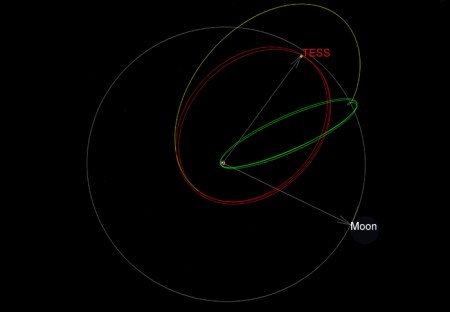
TESS
Talking to the media, Brad Tucker of the Australian National University said: “It’s changed our view of planets, it’s changed our view of our solar system and how common exo-planets are out there.” He further said that although Kepler discovered a number of planets, NASA failed to gather enough information about alien worlds due to their distance from the Earth. However, the new planet hunting telescope is a powerful one, added Dr Tucker. “It’s going to be a discovery machine. Our number of exoplanets is going to go through the roof,” he told the press.

The Kepler Space Telescope
For his part, Dr George Ricker from the Kavli Institute for Astrophysics and Space Research at the Massachusetts Institute of Technology stressed that the main task of the minibus-sized craft – having four wide field cameras that can see in the near-infrared spectrum – would be to look for dips in light as planets pass in front of their stars. He said that TESS would survey the whole sky after dividing it into 26 slabs. According to Dr Ricker, TESS will complete the survey in two years from its orbit situated within 100,000km of the Earth. “In 30-minute samples, Kepler was able to look at about 170,000 stars. TESS will be able to look at 30-50 million stars in that period,” he insisted.
At a time when the world is going through a turmoil and experiencing a war-like situation, NASA scientists are working hard to enrich this world with more information about the universe.
Boundless Ocean of Politics on Facebook: https://www.facebook.com/boundlessoceanofpolitics/
Boundless Ocean of Politics on Google Plus:
https://plus.google.com/+KoushikDasboundless
Boundless Ocean of Politics on Twitter:
https://twitter.com/kousdas?s=09
Contact us: kousdas@gmail.com

 ISMC
ISMC Boundless Ocean Of Politics