

Doesn’t Israel Need India, Too?
Almost 14 years after Ariel Sharon’s visit to India, another Israeli prime minister visited the South Asian country in the third week of January. During his January 14-20 trip, Benjamin Netanyahu hinted that he had a long-term plan for the Indo-Israel ties. Both Netanyahu and his Indian counterpart Narendra Modi made every attempt to earn ‘credit’ (from their countrymen) for strengthening the bilateral ties. In fact, it seems that they were much more interested in showcasing the ‘friendship’, instead of (actually) bolstering the ties.
Such an attempt was much expected from them, as both the leaders are going through a turbulent period as far as domestic politics is concerned. Although PM Modi’s party managed to win recently-held provincial elections in Gujarat, the margin of the victory had not been satisfactory. Similarly, the Netanyahu government is facing difficulties in tackling corruption-related issues in Israel. As a result, Netanyahu is desperately trying to exhibit his ‘Global Value’. Experts are of the opinion that the pressure of domestic politics influenced diplomacy, thus, encouraging the two countries to sign 14 agreements. Netanyahu admitted that the main purpose of his visit was to capture the huge Indian market in terms of defence, agriculture, energy, et al.
Both Modi and Netanyahu repeatedly mentioned the vastness of India’s ‘size’ and ‘scale’, and Israel’s ‘sharpness’ and ‘edge’ in their speeches. The move was not merely symbolic, but had a great implication in the current global geopolitical landscape. So, the Israeli premier’s recent visit to India was important diplomatically, politically and economically.
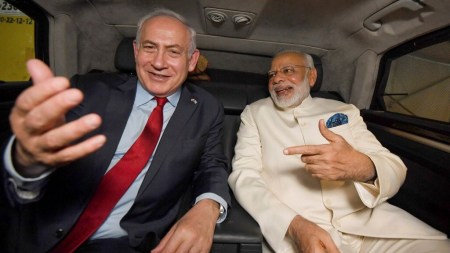
Netanyahu & Modi
From India’s perspective, the defence agreement was undoubtedly the most important one amongst them.
In April 2017, India planned to acquire defence items, worth USD 200 million, from Israel. However, the Modi administration changed its decision in the first week of January, with a senior Defence Ministry official saying that New Delhi might not import anti-tank missile technology, worth USD 50 million, from Jerusalem. Interestingly, Netanyahu’s recent visit resolved those issues, as India decided to purchase missiles from Israel once again, ignoring PM Modi’s ‘Make in India’ initiative. With this, India’s dependence on Israel for arms has reached a new level and it will automatically strengthen the bilateral ties. Jerusalem is well aware of the fact that India, despite its (anti-Israel) stand on the Palestinian issue, had no other option but to cement ties with Israel. And seemingly, Israel needs India at any cost, as well!
Bilateral trade agreements, too, are important for the two countries. Israel has agreed to increase its export to India by 25% in the next three years, although it is difficult to predict India’s ‘gain’ from this decision. This tour was a clear indicator of the success of Netanyahu’s foreign policy, popularly known as ‘Bibi Doctrine’.
For Israel, it would be a costly affair to export agricultural and defence products to India. The Israelis are looking for a huge market. The officials of Israel know that the Jewish nation will have to increase its export power. Or else, their market would not be strong. Now, India is ready to help Israel expand its market and to boost its economy.
Boundless Ocean of Politics on Facebook: https://www.facebook.com/boundlessoceanofpolitics/
Boundless Ocean of Politics on Google Plus:
https://plus.google.com/+KoushikDasboundless
Boundless Ocean of Politics on Twitter:
https://twitter.com/kousdas?s=09
Contact us: kousdas@gmail.com

 ISMC
ISMC Boundless Ocean Of Politics
This web site is mostly a walk-by way of for the entire data you wished about this and didn’t know who to ask. Glimpse right here, and you’ll undoubtedly uncover it.
LikeLike