

On An Indian In The Comintern
Although it sounds sort of exaggerated generalisation, there is no gainsaying about the powerful fact as articulated by one contemporary intellectual that “India’s history is a curiously unpeopled place. As usually told, it has dynasties, epochs, religions and castes-but not many individuals. Beyond a few iconic names, most of the important historical figures recede into a haze…”
It applies to Manabendra Nath Roy (March 21, 1887-January 25, 1954) in more than one sense. For it is just 63 years since his demise in the year 1954, it seems we have forgotten this hero so quickly despite his tremendous clout in mid-twentieth century, not only in India, but in Europe and Latin America as well, as a prolific anti-colonial cosmopolitan thinker. It evokes curiosity also because this oblivion explains two subtle points.
First, as young Professor Kris Manjpra of Tufts University has made clear that “the forgetting of MN Roy, his place as an Indian cosmopolitan icon manqué, in fact constitutes an important element of his historical meaning”. This meaning was crystallised through the web of his political activism in a number of sites and thus straddled between different places, including long years outside of India, and also which exposed him to variegated ideologies and identities, often distancing him intellectually as a lone ideologue searching for new horizon “outside the bounds of mainstream politics”.

Roy at the 2nd World Congress of the Comintern with Lenin & other Communists (1920)
According Professor Manjpra, “it was Roy’s role as an intermediary between worlds, while not centred in any, that paradoxically contributed both to his forgetting as a political figure, and to the power and widespread influence of his ideas”. That’s why, in case of Roy, any attempt to capture his intellectual and mindscape needs “a shift in attention away from territorial horizon of India to its deterritorial networks of thought and travel…” The book – entitled Prasangata: Manabendranath (MN Roy) – seems to seize the essence of this nuanced understanding as the author in his introductory comments says: “Sustho vabe banchar path khuje pete amader je manustir bhavna chintar kache jete hobe tini bisista chintabid ebang biswajure muktir swandhane byapak bhabe dhirgo path atikromkari Manabendranath Roy ba MN Roy.” (i.e. To search the sustainable path of life we need to recourse to the thought of Manabendranath Roy or MN Roy who was a path-breaking thinker and a veritable traveller across the world in the quest of liberation of human self.)
Another important and obvious process is epistemological construction within a spacio-temporal zone. It leaves clue as to how our memory is/should be shaped by the ruling ideology there and the exclusivity of history-making with its attendant ethnocentric disposition. But as regards Roy what we clearly perceive is the unconventional tour de force laced with broader orientation, universal aspect of his thought, whether that was communism with a global notion unfettered by mere Soviet hangover or transnational humanism of 1950s, what he himself termed ‘Radical Humanism’. This formulation of his matured ideas was not typically Indian but in tune with post-war humanism on a global scale and “Roy joined a transnational community of scholars who insisted on universalistic key-words-‘man’, ‘humanity’, ‘reason’, ‘peace’- not because they were proponents of ‘grand theory narratives’, but because they struggled to articulate and maintain hope in a period of trauma and vulnerability.”
Thus, going with the waves of time he built up snippets of his corpus, but there was sort of a pro-western slant in the sense all the themes like rationalism, science, equality that preoccupied his concern and discursive position, had their roots in European Enlightenment which he wished to transpose on Indian soil much like the Renaissance men. But time had changed and his role, had he been simply an anti-colonial Indian revolutionary would have one without the complex trappings of thought as a cosmopolitan intellectual of higher standing for which later he was profusely acclaimed.

Roy’s first wife Evelyn Trent
In fact, pains and possibilities of unique thinkers like MN Roy, therefore, lay in these ‘interstitial spaces of thought’ and life. Seen from this perspective, Roy who was naturally non-conformist and bold enough to swim ‘against the stream’, be it VI Lenin with whom he picked up debate in the Second Congress, or MK Gandhi whose style of politics (asceticism) he could not endorse. This makes clear as to how history is often told, thereby who is highlighted and above all, who gets to tell it.
It is, therefore, sad but not uncanny that Roy, who according to Sudipta Kaviraj, was ‘one who had all the makings of a major Indian leader’ had gone into obscurity. If this unravels the inner power dynamics that tends to couch the anti-colonial and post-colonial discourse, it becomes all the more imperative from the counter-hegemonic point to find the gaps carefully and filling them resolutely. So, from that point it’s not the question of a particular thinker per se, but broadly to trace those ideas that they had preached to make sense of the trajectory of modern India’s political thought and ‘praxis’.
The book authored by Debi Prosad Roy entitled Prasangata: Manabendranath (MN Roy), published from Pritonia, Kolkata, 2017, therefore, is to be viewed and studied in that context of an objective need for such an intellectual search which seems all the more pertinent in today’s context of crises when partisan politics, and its inevitable offshoot-political violence and corruption have not only endangered the democratic fabric of the country, but also individual liberty in our pluralist society.
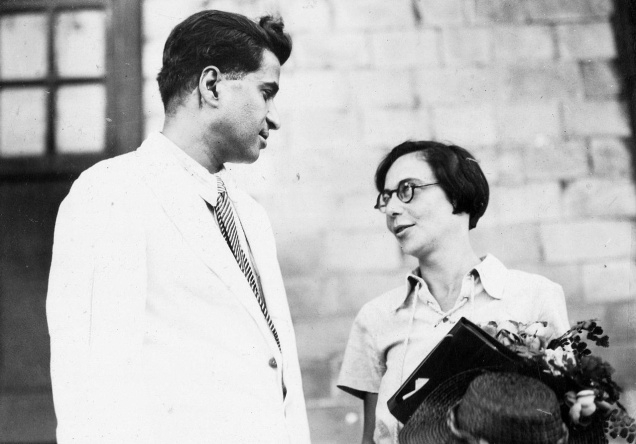
Roy with his second wife Ellen Gottschalk, Bombay, March 1937
The shifts in the political career of ‘the peripatetic radical intellectual’ MN Roy stands as a veritable protest against this ubiquitous political rot, against the very tendency that seeks to ‘transform India into a singular religious concoction’. His doctrine of new humanism or radical humanism was indeed an anathema to this communally motivated reductionism, to restore the rightful, creative place of the individual untrammelled by social or statal inhibitions.
It is important to remember that when from 1930s onwards Gandhi’s views on the nature of the state and the functions of the government underwent signal change in the sense of certain appreciation that state had a vital role to play in promoting socio-economic justice, MN Roy, on the other hand, had strong reservation against the state or any such collectivist or rigid institutional will defiant of controlled use by the individuals since the culmination of his thought led him to gravitate towards different direction, towards rational and secular individualism as a bull work of democracy. To him, “Collectivism, economic reorganisation, abolition of private property in the means of production – none of these are the measure. The measure can only be man; that society which gives the greatest measure of freedom to the individuals is the freest society.” (Quoted by the author from Roy’s book New Orientation).
This sublimation paving the way to humanist philosophy which Roy so vociferously advocated and passionately campaigned for, was conceived to be the impelling force for the awakening suffice to create a just and ideal social order. For there the coveted goal with the restoration of the ‘position of primacy and dignity’ of the individual would be achieved and which would “show the way out of the contemporary crisis of modern civilisation.” Yet the question persists as where are we heading to or how we are getting entrapped into the abyss and snare of power conflict, violent clash of interests stemming from the scramble for power, will to dominate and dogmatism in approach.

Subhas Chandra Bose With Mr & Mrs Roy
Still today, it seems people are the worst victims of the power structure in whose name anti-people policies and newer taxations continue to be heaped upon our society and centralisation of power goes on unabated. Similarly, in the name of globalisation, we are being pushed to accept the consumerist happy-go-life-culture or what Georg Simmel once dubbed as Americanisation. This catchall phrase of transnational ‘third culture’ points to the impending danger as it may jeopardise our long-held values of harmony, solidarity, creativity and love for moral axioms.
In the circumstances, it seems necessary to turn our attention once again to the ideational harvest of the courageous, value-laden, radical intellectual tradition which MN Roy had represented cogently and unflaggingly. The current book is a welcome enterprise of lucid scholarship, a product of perceived urgency of renewed discussion on this man of genius and his cosmopolitan philosophy in the present epoch of tumultuous time.
Of course, treading through Roy is also like taking a glimpse of 67 years of contemporary world history and the rise and decline of ideologies, which is a blissful experience indeed.
Boundless Ocean of Politics has received this article from Dr. Gouri Sankar Nag, the Associate Professor and Head of the Department (Political Science) at Sidho-Kanho-Birsha University, Purulia, West Bengal, India.
It may be added that the book – Prasangata: Manabendranath (MN Roy) – is divided into 14 chapters, containing 20 odd rare photographs, including those of Rosa Luxemburg, Roy’s wives Evelyn Trent and Ellen Gottschalk, German leftist leader August Thalheimer, and a world map depicting his journey from India and back to India.

Rosa Luxemburg
A list of his 20 books, and 12 books and journals on him would definitely help the future researchers on MN Roy.

August Thalheimer
A selection of the book should be translated in different Indian and foreign languages.
This article has been prepared by the author, keeping in mind the death anniversary of MN Roy, for the IRHA newsletter.
Editor’s note: The views and opinions expressed in this article are the author’s and do not necessarily represent the views and opinions of Boundless Ocean of Politics. Boundless Ocean of Politics makes no representation, warranty or guarantee as to the accuracy or completeness of the information contained in any News, Research, Analysis or Opinion provided in this article. Under no circumstances will Boundless Ocean of Politics, its employees, agents or affiliates be held liable by any person or entity for decisions made or actions taken by any person or entity that relies upon the information provided in this article.
Boundless Ocean of Politics on Facebook: https://www.facebook.com/boundlessoceanofpolitics/
Boundless Ocean of Politics on Google Plus:
https://plus.google.com/+KoushikDasboundless
Boundless Ocean of Politics on Twitter:
https://twitter.com/kousdas?s=09
Contact us: kousdas@gmail.com

 ISMC
ISMC Boundless Ocean Of Politics