

India Remembers Its Braveheart
The global community will mark the centenary of the end of the WWI later this year.
The Great War, which lasted for four years, ended in November 1918. It was decided that the ceasefire would be declared at 11:00 hours on the 11th day of the 11th month. After the declaration of ceasefire, the history, as well as the geography, of the world changed.
The world witnessed the fall of three empires – the Austro-Hungarian Empire, the Ottoman Empire and the Russian Empire (Tsar) – after the WWI. As a result, the maps of Europe and West Asia were redrawn.
Nearly 15 million Indian soldiers took part in the WWI. In fact, they fought in the battlefields on foreign soils for the first time and more than 72,000 Indians sacrificed their lives while fighting for Britain.

Indra Lal Roy
India is all set to mark the death centenary of Indra Lal Roy, the sole Indian WWI flying ace. Roy – who claimed 10 aerial victories, destroyed five aircraft (one shared) and five ‘down out of control’ (one shared) in just over 170 hours flying time while serving in the Royal Flying Corps and its successor, the Royal Air Force – died on July 22, 1918 at the age of 19.
Roy was killed over Carvin, France in a dog fight against the Fokker D.VIIs of Jagdstaffel 29. As per the British war documents, four German aircraft attacked Roy’s plane, and the first and only Indian flying ace of the WWI sacrificed his life.
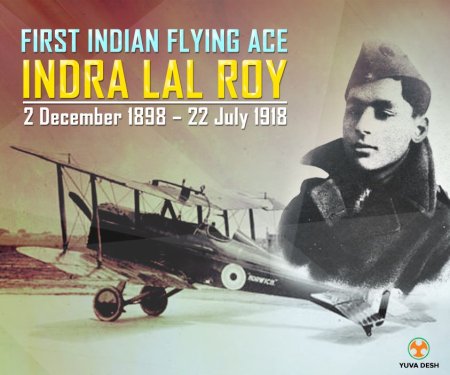
The braveheart – nicknamed ‘Laddie’ – was fighting with courage. But his damaged plane fell straight to the ground near the German border and caught fire. Surprisingly, Roy shot down two German aircraft while falling from the sky. Later, he was buried at Estevelles Communal Cemetery in Pas-de-Calais, France. Roy was posthumously awarded the Distinguished Flying Cross (DFC) and he was the first Indian to receive this military decoration.
“Lieutenant Indra Lal Roy was a very gallant and determined officer, who in 13 days accounted for nine enemy machines. In these several engagements, he has displayed remarkable skill and daring, on more than one occasion accounting for two machines in one patrol,” read his citation.
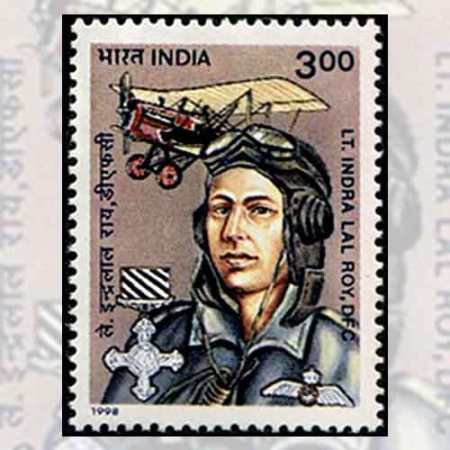
The Indian Postal Service issued a commemorative stamp in his honour on his 100th birth anniversary on December 2, 1998.
Roy’s nephew Subroto Mukerjee (March 5, 1911-November 8, 1960), too, served as a fighter pilot in WWII before becoming the first Indian Commander-in-Chief, as well as Chief of Air Staff of the Indian Air Force.
Boundless Ocean of Politics on Facebook: https://www.facebook.com/boundlessoceanofpolitics/
Boundless Ocean of Politics on Google Plus:
https://plus.google.com/+KoushikDasboundless
Boundless Ocean of Politics on Twitter:
https://twitter.com/kousdas?s=09
Contact us: kousdas@gmail.com

 ISMC
ISMC Boundless Ocean Of Politics