

Do Business With China, Stay Close To India, US
The Malcolm Turnbull government in Canberra has released a ‘foreign policy white paper’, highlighting Australia’s close ties with India, Japan and the US.
In the white paper, Australia clearly mentioned that Canberra’s interests in the “Indo-Pacific” region would shape the Australian foreign policy in the coming days. It has also been mentioned in the paper that the close co-operation between Australia, Japan, the US and India would ensure regional (and global) peace.
Prime Minister Turnbull said over the weekend that Australia was trying hard to counter China’s growing influence in the Indo-Pacific region by joining hands with countries, which “share our interests and commitment to rules-based institutions”.

Malcolm Turnbull
Although the main opposition – Labour party – is not ready to accept the “quadrilateral” as the cornerstone of Australian foreign policy, the Aussie premier believes that only the ‘quad’ can counter the Chinese influence in the Indo-Pacific (and not the Asia-Pacific) region.
Interestingly, Turnbull admitted that China emerged as an economic giant and it would not be possible for Australia to snap ties with Beijing. According to the Aussie premier, Canberra would maintain close economic and trade ties with China, but strengthen strategic and security ties with the US, Japan and India.
The PM told the media: “A good example is when officials of Japan, India, the US and Australia met in the margins of the East Asia Summit in Manila earlier this month. I discussed the importance of this initiative with (Indian) Prime Minister Narendra Modi at our meeting. Another was my meeting with Prime Minister Nguyen Xuan Phuc in Vietnam earlier this month, where we agreed to work towards signing a strategic partnership.”
Commenting on Australia’s strategic dilemma, the premier said: “This is the first time in our history that our dominant trading partner is not also our dominant security partner.” He further admitted China’s contribution to the Australian economy and society, saying that it has become difficult to bolster security and defence ties with the Asian giant because of its aggressive foreign policies. So, according to Turnbull, Australia is trying to revive the “quad”.
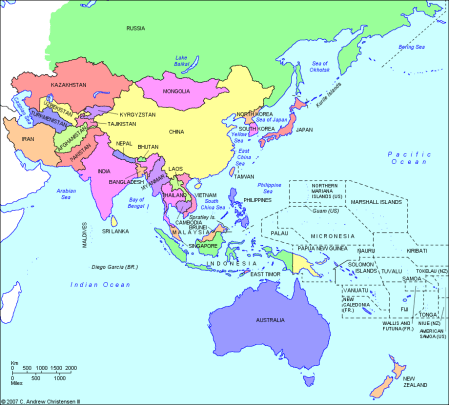
Indo-Pacific
Meanwhile, the PM revealed that his government would soon release an ‘India strategy paper’, describing the Australian vision of the Indo-Pacific. Turnbull insisted that foreign policy makers should avoid the “might is right” attitude or else a country would have to face dire consequences in the current global geopolitical scenario. He described “a neighbourhood that is defined by open markets and the free flow of goods, services, capital and ideas”, saying that big powers should respect the smaller states’ ‘freedom of navigation’, if they really wanted to ensure global peace.
Rowan Callick, a columnist for ‘The Australian’ in China, said that Beijing would never accept the word ‘Indo-Pacific’. “The term Indo-Pacific has become identified with the resurrection of the quadrilateral dialogue between India, Japan, the US and Australia, viewed by some in China as a ‘containment’ strategy, a word intended to arouse memories of the ‘century of humiliation by foreign powers’ that occupies a central place in Chinese history books,” stressed Callick.
Boundless Ocean of Politics on Facebook: https://www.facebook.com/boundlessoceanofpolitics/
Boundless Ocean of Politics on Google Plus:
https://plus.google.com/+KoushikDasboundless
Boundless Ocean of Politics on Twitter:
https://twitter.com/kousdas?s=09
Contact us: kousdas@gmail.com

 ISMC
ISMC Boundless Ocean Of Politics