

Quadrilateral Meet Mounts Pressure On China
On the sidelines of the ongoing ASEAN Summit in Manila, four global powers formed a strong alliance in order to serve their interests in the Asia-Pacific region earlier this week.
America, Australia, India and Japan agreed to work together in huge areas spreading from the Indian Ocean to the Pacific in order to keep China under tremendous pressure. Although the four friendly nations had decided to join hands in an attempt to work for an open ‘Indo-Pacific’ zone, they had no plan to form the “quadrilateral” circuit in the past. The quadrilateral resurrected from the ashes after top officials of these countries exchanged views on addressing common challenges of terrorism and proliferation linkages affecting the region and also on enhancing connectivity.
Later, American, Australian, Indian and Japanese officials informed the press that the main aim of the newly-formed axis is to foil China’s plan to establish absolute supremacy in the Asia-Pacific region and also in the Indian Ocean.
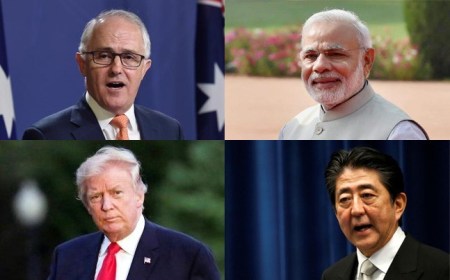
In a statement, the Indian Ministry of External Affairs said that the four nations would boost connectivity between them in order to ensure peace, stability and prosperity of the region.
Australia, too, issued a similar statement, saying: “The officials examined ways to achieve common goals and address shared challenges in the region. This includes upholding the rules-based order in the Indo-Pacific, freedom of navigation and over-flight and to increase connectivity.”
Interestingly, US President Donald Trump openly re-named the Asia-Pacific to ‘Indo-Pacific’, indicating that Washington was ready to put India front and centre in its ‘Asia strategy’. And (in a rare first) a US ship refuelled an Indian warship in the East China Sea soon after President Trump arrived in the Filipino capital to attend the ASEAN Summit on Monday.

There is absolutely no doubt about what the four powers want to mean by saying that their main aim is to maintain the “rules-based order” in the Indo-Pacific theatre. America, Australia, India and Japan have never recognised China’s move to create artificial islands in the South China Sea and to claim the ‘Nine-Dash’ line as its territory. The move made by the ‘powerful four’ only refers to Beijing’s expansionist policy. Even an international tribunal in The Hague found in July 2016 that China’s expansive claim to sovereignty over the South China Sea waters had no legal basis. The axis made clear that one of the main goals of the quadrilateral is to implement the international tribunal’s verdict by recognising the South China Sea as the international waterway.
Keeping in mind the changing global geopolitical landscape, China (perhaps) is able to realise that it will be difficult to tackle the axis in the coming days. The (November 13-16) ASEAN Summit is due to conclude on Thursday.
Boundless Ocean of Politics on Facebook: https://www.facebook.com/boundlessoceanofpolitics/
Boundless Ocean of Politics on Google Plus:
https://plus.google.com/+KoushikDasboundless
Boundless Ocean of Politics on Twitter:
https://twitter.com/kousdas?s=09
Contact us: kousdas@gmail.com

 ISMC
ISMC Boundless Ocean Of Politics