

When Freedom Of Expression Was Considered As Crime
“I’m not against you. I just have a different idea about art…..”
Władysław Strzemiński’s only fault was that he said this during interrogation. In December 1948, he was questioned by senior Polish officials at the headquarters of the ruling Communist Party in Warsaw. But why did the police of the socialist government arrest him?
One day, Strzemiński was busy with his painting. Suddenly, he realised that the ruling Communist Party was holding a meeting just outside his flat. From the window, he saw that a huge red festoon of Joseph Stalin covered the wall of his building. Strzemiński also discovered that the festoon made his room as red as possible due to the reflection of sunlight. The painter went to the balcony and tore the festoon with his crutch, thus, allowing the sunlight to enter his room directly. As Strzemiński lost a hand and a leg during WWI, his only companion was his crutch. His move stunned members of the Communist Party and they decided to ‘punish’ Strzemiński for committing the ‘crime’.
We should remember the scene of Andrzej Wajda’s last movie ‘Afterimage’ (especially on the eve of the centenary of November Revolution). On November 7, the whole world will mark the 100th anniversary of the Great Revolution. Those ‘ten days that shook the world’ transformed the socio-economic structure of Russia in 1917. The revolution also had a great impact on art and culture.
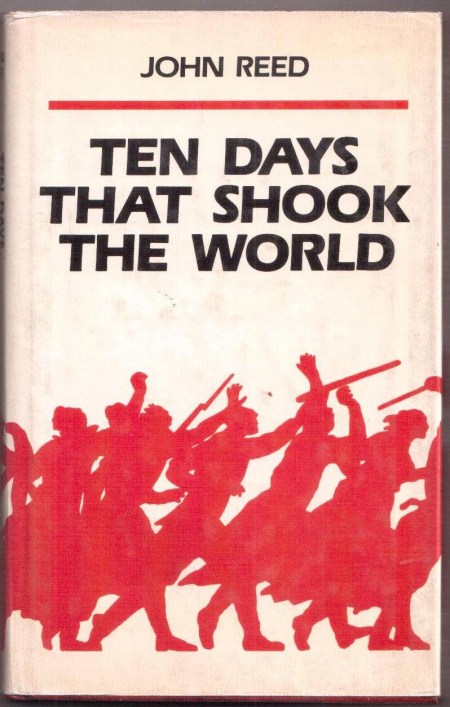
A controversy or disagreement over the new approach to art and culture was there in the early days of socialism. (At least) for the first few years during Lenin’s period, people with alternative thought got the opportunity to freely express their views on different issues. They didn’t face any problem even during the supremacy of the Communist Party. Experiments were going on how revolutionary changes could be made in terms of the content at that time. For example, we can mention Eisenstein’s movies and Mayakovsky’s poetry.
Strzemiński (1893-1952) was doing just that in Poland. The Polish avant-garde painter became famous because of his revolutionary thought and expression. The founder of Poland’s first ‘Museum of Modern Art’ formed a revolutionary group of artists. During the 1920s, Strzemiński formulated his theory of Unism and inspired the Unistic musical compositions of Polish composer Zygmunt Krauze with his Unistic paintings. He also penned a revolutionary book – ‘The theory of vision’. He moved to Wilno (now Vilnius) in 1922 and supported Vytautas Kairiūkštis in creating the first avant-garde art exhibition in Lithuania (then under Polish rule) in 1923. In November 1923, the painter moved to Warsaw and founded the constructivist group ‘Blok’ jointly with Henryk Berlewi.

Władysław Strzemiński
Still, Strzemiński faced ire of the Soviet government. At that time, the Communist Party of Soviet Union became all powerful under the leadership of Stalin. Due to centralisation of power, the party became more powerful than the state and destroyed the ‘democratic’ characters of the socialist system in Soviet Union. As a result, common people started losing faith in socialism. In an article, eminent Marxiologist and Professor (Retired) of Calcutta University Dr Sobhanlal Dutta Gupta recently said: “The Russian people were unaware of the very close relationship between socialism and democracy.” And gradually, the system turned into a ‘military socialism’.
After the WWII, people, like Strzemiński, thought that their countries would follow the path of democracy. However, the “democracy-less socialism” shattered their dreams. When Soviet Union took over the control of war-ravaged East European countries after the war, the people of those countries did not accept the ‘imposition of socialism’. For them, the socialist system became a new era of pain.
Artists were most affected, as their freedom of expression was curtailed. Strzemiński was asked to study ‘Socialist Realism’, a doctrine popularised by the Communist Party. The communists used to believe that the presence of this type of artists was necessary for the formation of the nation and others were useless, because they were the products of capitalism. Once, Strzemiński told the Polish culture minister: “Art is the laboratory of its different forms and expressions. People respect art and artists not because of their effectiveness or utility, but because of their quality.” Almost immediately, the minister made clear that the nation won’t need Strzemiński. He said that socialism would never recognise formalistic art or avant-garde.

Andrzej Wajda
Noted Indian film director Satyajit Ray once said: “If the government defines the art, then artists cannot enjoy freedom. Kremlin criticised stalwarts, like Eisenstein, Pudovkin, Dovzhenko and Donskoy, for their screenplays. But do we have the courage to say that they are not talented film-makers? In fact, Ray encouraged Wajda to make the film on Strzemiński. “’In my film, I have warned that the state can’t interfere in an artist’s work. There may be different forms of art and an artist should enjoy the freedom of expression. I fully agree with Strzemiński that innovative ideas make an artist immortal. Only artists can show the new path,” stressed Wajda, who passed away in October 2016 at the age of 90.
Strzemiński died in December 1952. The communist government blocked his ID card and the Artists’ Forum cancelled his membership. As he had no ID card, the painter was unable to buy foods, colours and even cigarettes. The minister told Strzemiński that he should be killed in a tram accident. Effectively deprived of the means of making a livelihood, the great artist died of tuberculosis. During his last years, Strzemiński attempted to effect a compromise with the principles of Socialist Realism, but the works he produced were unacceptable to the cultural authorities.
Wajda’s movie portrays an artist’s apathy and helplessness in a snow-covered Polish city. Perhaps, we forget Strzemiński when we mark the centenary of Bolshevik Revolution on November 7.
Boundless Ocean of Politics on Facebook: https://www.facebook.com/boundlessoceanofpolitics/
Boundless Ocean of Politics on Google Plus:
https://plus.google.com/+KoushikDasboundless
Boundless Ocean of Politics on Twitter:
https://twitter.com/kousdas?s=09
Contact us: kousdas@gmail.com

 ISMC
ISMC Boundless Ocean Of Politics