

It’s Symbolic
Indian Prime Minister Narendra Modi has hinted that his government will soon (re)introduce the ‘Women’s Reservation Bill’ in the Parliament, as he is eager to pass the Bill during the Winter Session. Immediately after receiving the news, President of the opposition Congress Party Sonia Gandhi wrote a letter to the PM, suggesting that her party had actually planned to pass the Bill few years ago.
As far as the current political scenario in India is concerned, the Bill is expected to be passed in the Parliament. It will allow the government to reserve one-third or 33% of all seats (545) in the Lower House of the Indian Parliament or the Lok Sabha and in all provincial Legislative Assemblies for women. The seats were proposed to be reserved in rotation and would have been determined by draw of lots in such a way that a seat would be reserved only once in three consecutive General Elections.
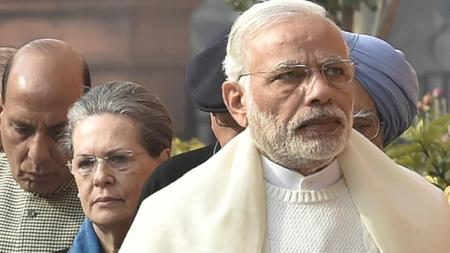
Modi & Sonia Gandhi
The Upper House of the Parliament or Rajya Sabha had passed the Bill on March 9, 2010. However, the Lok Sabha never voted on the Bill and the Bill lapsed after the dissolution of the 15th Lok Sabha in 2014.
Although some leaders opposed the Bill in the past, all the major parties are currently backing the government’s move. So, the Winter Session of Parliament can create history, if the Modi government introduces the Bill.
Meanwhile, women’s rights activists have raised an important question: is it possible for the Bill to change women’s status in the South Asian country? Indeed, it’s a difficult question.
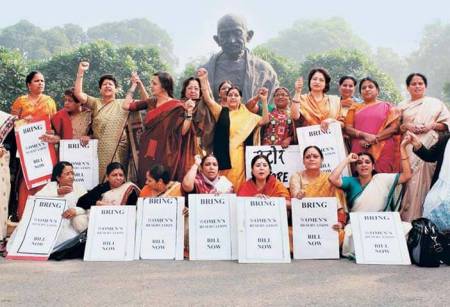
Indian women MPs
The main essence of the Women’s Reservation Bill is symbolic. Even today, only 12% of Indian MPs are women. In such a scenario, the PM’s initiative is important. Prime Minister Modi, who is well aware of the fact that the Indian society is against women’s empowerment, has made clear that the state is ready to give the ‘power’ to them. A section of the Indian society still believes that women should stay inside their homes. But, the PM (read the state) is supporting the concept that women, like men, have every right to enjoy freedom and join different activities. The PM’s decision is also significant in current social circumstances, keeping in mind the increasing incidents of crime against women in India.
The Women’s Reservation Bill will definitely establish the fact that there is no difference between men and women at workplaces (or in modern-day India). So, the importance of such a Bill is huge in a country, where only 27% of women are working in various sectors.
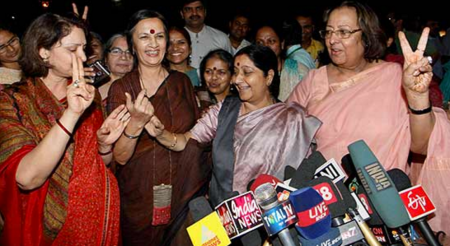
At the same time, it’s also important to discuss the moral arguments in favour of women’s reservation. The Bill will certainly help women, who are very poor and victims of socio-economic discrimination, stand on their feet. But, there is no need to reserve seats for daughters and wives of millionaires and influential leaders. Or else, such a move will send a wrong message to women’s rights activists and to those, who are trying hard to protect women’s dignity in the Indian society.
Also, it is important for us to know that if all the parties are really interested in empowering women, then why don’t they nominate female candidates (at least in half of the seats) during elections? In fact, India has a long tradition of using women as pawns in politics. It will be interesting to see how the entry of 182 women into the Lower House of the Parliament can change the lives of 600 million women in India.
Boundless Ocean of Politics on Facebook: https://www.facebook.com/boundlessoceanofpolitics/
Boundless Ocean of Politics on Google Plus:
https://plus.google.com/+KoushikDasboundless
Boundless Ocean of Politics on Twitter:
https://twitter.com/kousdas?s=09
Contact us: kousdas@gmail.com

 ISMC
ISMC Boundless Ocean Of Politics