

Russia Reveals Cables Sent By British Double Agent
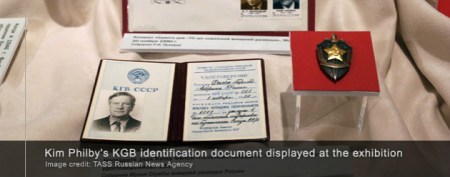
In a rare first, Moscow has made public secret documents handed over to his Soviet handlers by British double agent Kim Philby. Currently, the concerned authorities in Moscow display those documents in an exhibition.
Philby, widely considered as the KGB’s one of the most productive Western recruits and the biggest Cold War traitor of Britain, sent those information to Moscow from the 1930s to 1963. Finally, he was ‘uncovered’ by the British intelligence officers and fled to Soviet Union, where he died in 1988 at the age of 76. Like KGB, its successor agency – the FSB – still considers Philby as a hero.

Kim Philby
Sergei Naryshkin, the Director of Russian foreign intelligence service SVR, inaugurated the exhibition – ‘Kim Philby in espionage and in life’ – at the Russian Historical Society on September 26. He told the audience that it was a golden opportunity for the visitors to know about the British agent. “Philby was able to do a lot to change the course of history, to do good and bring about justice. He was a great citizen of the world,” Naryshkin said in the presence of some KGB veterans once mentored by Philby.
Philby was one of the members of ‘Cambridge Five’, the famous spy ring recruited by Soviet Union during their time at the University of Cambridge in the 1930s. Most of the documents, displayed in the September 26-October 5 exhibition, were sent by him in the 1940s. Later, the British cables – marked “top secret” in red – found their places in the archives of the SVR. Philby addressed one of the documents personally to Joseph Stalin and Soviet Foreign Minister Vyacheslav Molotov. After Stalin’s death, the document was translated into Russian language.
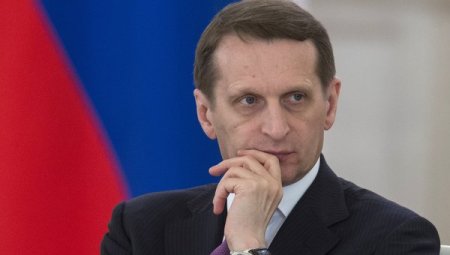
Sergei Naryshkin
Another document is a 1944 cable which Philby intercepted from the Japanese ambassador in Italy. In this document, the Japanese diplomat mentioned about his meeting with Italian dictator Benito Mussolini. The third one reveals information about British and American operations in Albania in 1949.
Konstantin Mogilevsky, head of the Kremlin-backed History of Fatherland Foundation, said that members of the foundation worked really hard to organise the exhibition. He highlighted the importance of Philby in Soviet history, saying that the British agent helped Soviet Union win the WWII by providing crucial information. “Thanks to Philby, all of these reached Stalin’s desk. Philby was a patriot of both his homelands: Britain and the Soviet Union. He never put the lives of his British colleagues in danger,” added Mogilevsky.
According to Mogilevsky, Philby was just like Edward Snowden, who leaked details of US surveillance programmes before taking asylum in Russia. “What Snowden did was not for money or to make his life better….quite the opposite, he made it a lot worse. In that sense, they are similar. Russia has always valued those kinds of motives,” he told the audience who visited the exhibition on the first day.
Rufina Pukhova-Philby, the 85-year-old Russian widow of Philby, too, attended the opening ceremony. She recalled that before leaving Beirut on January 23, 1963 (immediately after a KGB handler warned him he had been uncovered), Philby told his first wife Eleanor that he would meet her at a restaurant for dinner. However, he left Beirut on a cargo ship and reached Odessa in Ukraine, and then arrived in Moscow. Meanwhile, the organisers thanked Pukhova-Philby for contributing cigars that Philby received from Cuban leader Fidel Castro and an armchair formerly owned by another member of the Cambridge Five, Guy Burgess. Burgess, too, defected to Moscow and died in 1963.
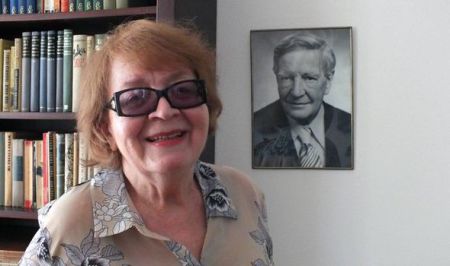
Rufina Pukhova-Philby
For his part, Sergei Grigoryants, a rights activist who studies Russia’s secret services, said that Philby was a ‘special one’ for the Russian intelligence community “who has a sense of nostalgia for their Soviet heyday”. “There is a huge longing for those years. They are upset that Russia’s current spies are people who are in it for money or as a result of blackmail, but not for ideological motives like in the 1930s,” he told the press.
According to Grigoryants, Philby struggled a lot to adopt the Soviet culture, as he was kept under surveillance. “He didn’t understand the world around him,” insisted Grigoryants. However, Philby remained a die-hard Communist until his death. He once said: “May we all live to see the red flag hanging over Buckingham Palace!”
Boundless Ocean of Politics on Facebook: https://www.facebook.com/boundlessoceanofpolitics/
Boundless Ocean of Politics on Google Plus:
https://plus.google.com/+KoushikDasboundless
Boundless Ocean of Politics on Twitter:
https://twitter.com/kousdas?s=09
Contact us: kousdas@gmail.com

 ISMC
ISMC Boundless Ocean Of Politics