

When Ramallah Was On Fire
He was facing a serious threat in his hometown as both the police and the moral police were ready to punish him. People, using foul languages on his Facebook wall, asked him to stay inside the room, or else face the consequences. Even, they asked bookstores and libraries across Ramallah not to keep the novel authored by him. These incidents ‘shocked’ Abbad Yahya, the 29-year-old Palestinian author and novelist who worked previously as a researcher in the ِArab Centre for Research and Policy Studies. All of a sudden, the editor-in-chief of Ultrasawt discovered that ‘his’ Ramallah changed a lot.
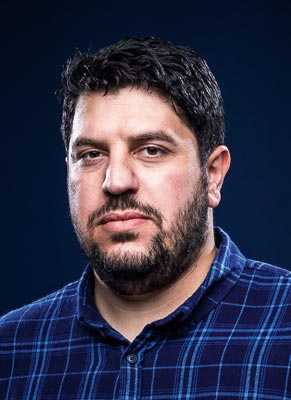
Abbad Yahya
Yahya was in Qatar in February 2017 when he came to know that people across Palestine were angry with his fourth novel, ‘Crime in Ramallah’. The concerned authorities in Palestine were of the opinion that Yahya used ‘dirty’ words in his novel, written in Arabic. Yahya has also been accused of including ‘sexual terms’ in his ‘provocative’ work that tackles issues considered taboo in Palestinian society. So, the book has been banned.
Ahmed Barak, Palestine’s Attorney General, backed the move, saying that the novel contained “indecent texts and terms that threaten morality and public decency, which could affect the population, in particular, minors”. The decision “does not violate freedom of opinion and expression”, he stressed. Barak also slammed the author for dealing with politics, religion and homosexuality in his novel.

Crime in Ramallah
Later, the police confiscated copies of Yahya’s latest novel and issued a warrant for his arrest, apart from asking bookstores across the West Bank not to sell the novel. Luckily, Yahya was not in Palestine at that time. Otherwise, it would have been difficult for him to survive.
Indeed, it was a shocking incident. Ramallah has a great cultural tradition. The city, just 10km away from Jerusalem, is considered as a business hub in Palestine. The business structure has been developed in the Palestinian city in the 21st century. The city also houses embassies of India, Japan, Germany, Argentina and other countries. A couple of years ago, the American media described Ramallah as the “real capital” of Palestine because of the construction boom and tremendous growth of the IT industry there.
The city allowed writers and other creative personalities to enjoy freedom even during the war with Israel or the missile attack. Special permission was required to go to Jerusalem from Gaza Strip or other Palestinian cities, but not from Ramallah. In fact, Israel had made a number of bypasses to boost the connectivity between Jerusalem and other main cities after acquiring lands from Ramallah residents. They lost their lands at a time when there were no employment opportunities in Palestine. In 2000, the residents of Ramallah gathered near the bypasses, which were ‘only for Israelis’, to stage protests. One day, the Israeli fighter jets covered the sky of Ramallah, and the Israeli forces took control of the local television station and imposed curfew.

Ramallah
However, the Israelis failed to destroy the Palestinian city. Yasser Arafat, the leader of the Palestine Liberation Organisation (PLO) who used to stay in the Gaza Strip with his family, opened his office in Ramallah. Thousands of people still visit his mausoleum in this Palestinian city.
Ramallah witnessed a historical event in 2005. Janet Mikhail – sometimes known as Janet Khouri, a Roman Catholic who served as head teacher of a girls’ school in Ramallah for 20 years – was elected as mayor of the city. She was the first woman to hold this post. So, Ramallah doesn’t mean just West Bank and Israel-Palestine war.
Yahya wanted to portray the real picture of the city in his novel. In the past, he penned four books and all of them became popular. The banned novel, ‘Crime in Ramallah’, is the story of three Palestinian youths – Rauf, Wisam and Nur. In this novel, Yahya’s narrator Nur remembers his adolescence in Palestine, marked by the second intifada. Their lives have been engulfed with the bloody history of Palestine and Israel. As they grow up, Rauf, Wisam and Nur realise that the Palestine-Israel war constantly influences their lives. They have to ‘sacrifice’ their freedom due to the political turmoil. Yahya finds that everybody talks about ‘nationalism’ and ‘freedom’ in Ramallah, but the environment is not so good there to enjoy freedom. Apparently, it seems that people in Ramallah are ‘liberal’ and ‘progressive’. But, they are basically ‘conservatives’.
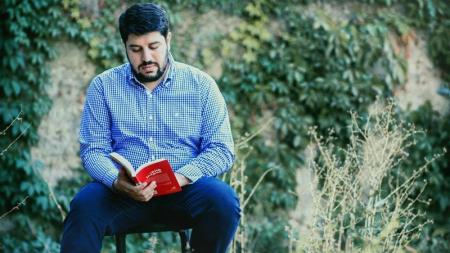
Abbad Yahya
Rauf, a village boy, meets a girl after getting admission in Ramallah University. However, he doesn’t get an opportunity to talk to the girl and express his love. Rauf does not even know her name. For him, she becomes ‘Dunya’ (means ‘the world’ in Arabic) or his ‘dream world’ in the loveless city. Meanwhile, Nur arrives in Ramallah to ‘change’ his life. Nur, a gay, is broken-hearted after the breakup with his ‘boyfriend’. Wisam’s life is comparatively peaceful, as he has a stable white-collar job. However, the murder of his girlfriend changes his life. For the three young people, it becomes really difficult to bear the ‘burden of their lives’. Yahya’s novel tells the story of ‘disappointed’ young Palestinians.
Then, why the novel becomes controversial? The real problem lies elsewhere. Actually, Yahya didn’t blame the Palestinian government in his novel. He never said that the government failed to perform its duty. Rather, he highlighted the claustrophobia experienced by the Palestinian youths. Yahya tried to find the root cause of their anger. On a Ramallah street, Nur discovers a poster of Yasser Arafat, with a large machine gun in his hands. Nur thinks that the great leader is not holding a firearm, but a male organ. This is how frustration of a gay youth resists mass-icon hysteria in Yahya’s novel.
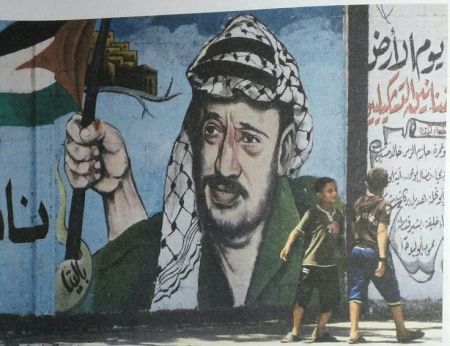
Arafat poster
‘Crime in Ramallah’ exposes the dark side of the Palestinian city. Nur’s family supports the Hamas movement. Hamas members are regular visitors to the shop run by Nur’s father. His father donates a huge amount of money to different organisations in order to please all the parties. So, the family lives ‘peacefully’. Even, the police don’t touch them. Nur’s sister-in-law is a social activist. Her main job is to find ‘Hamas brothers’ for the widows of ‘Hamas martyrs’. When everyone sleeps at night, Nur switches on the television to enjoy movies and music videos.
All these ‘different types’ created problems for Yahya. The local administration strongly criticised the author for using ‘dirty’ words, like sex and masturbation, and also for expressing unpleasant political opinion. The head of the Palestinian writers’ union and the Hamas movement (too) criticised Yahya.
Members of a local ‘Book Club’ in Ramallah decided to organise a discussion on Yahya’s novel. But, they had to cancel the event after receiving threatening phone calls.
However, human rights organisations decided to provide all sorts of help to Yahya so that he could return to Ramallah. Head of the PLO’s Cultural Department, too, condemned the concerned authorities’ decision to ban the novel, saying that such a move was an attack on the PLO that was formed to fulfil the dream of building an ‘independent and sovereign’ Palestine. The German ‘PEN’ Centre, which provides grants for writers who face persecution in their home countries, invited Yahya to join its ‘The Writers in Exile’ programme.
Still, the young Palestinian writer is upset. He failed to understand why his (kn)own Ramallah suddenly became a ‘stranger’!
Boundless Ocean of Politics on Facebook: https://www.facebook.com/boundlessoceanofpolitics/
Boundless Ocean of Politics on Google Plus:
https://plus.google.com/+KoushikDasboundless
Boundless Ocean of Politics on Twitter:
https://twitter.com/kousdas?s=09
Contact us: kousdas@gmail.com

 ISMC
ISMC Boundless Ocean Of Politics