

Rohingya: The World’s Most Persecuted Minority
The 20-year-old Nurjahan, along with her sister, has been staying at a home in India for the last five years. They had no other option, but to leave their ‘homeland’ in order to ‘protect’ themselves from the ‘state’. Upon their arrival in India, the two sisters went straight to the police, as they thought that the police would help them find a shelter. However, the police sent them to a home. Nurjahan still believes that she will return to her country one day.
Nurjahan is not alone. There are thousands of Rohingya women (and men) from Myanmar’s Rakhine province who have taken shelter in neighbouring India and Bangladesh. The Rohingyas are a Muslim minority group in Myanmar. Ethnically, they are much closer to the Indo-Aryan people of India and Bangladesh than to the Sino-Tibetans of the South-east Asian country. They speak a dialect of Bengali and live in Rakhine province.
Ethnic groups, as well as the Myanmarese government, have called Rohingyas foreign immigrants. But, Amnesty International says that they have been living on Rakhine coast since the 8th century. There was substantial Muslim migration during the British colonial period.
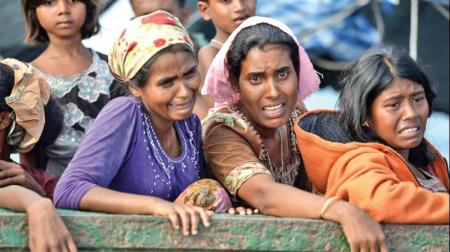
According to UN High Commissioner for Refugees (UNHCR), the 1982 citizenship law deprived the Rohingyas of Myanmar citizenship. This has resulted in deprivation of their fundamental rights and persecution on the basis of ethnicity.
Meanwhile, Rohingya women have no idea that New Delhi and Dhaka have planned to send them back to their homeland. The Indian government issued a directive for them on August 8 in which it was clearly mentioned that Rohingyas from Rakhine province would be identified and sent back to Myanmar. Even, those, who received refugee cards from the UNHCR, could not stay in India.
However, Rohingyas don’t want to return to their country as they know that the Myanmarese Army is ready to welcome them with bullets. Despite knowing this, the Indian government wants to send them back. In the first week of August, Indian Minister of State for Home Affairs Kiren Rijiju clarified that the country’s sovereignty and security would be compromised, if the government allowed Rohingyas to stay here in India.
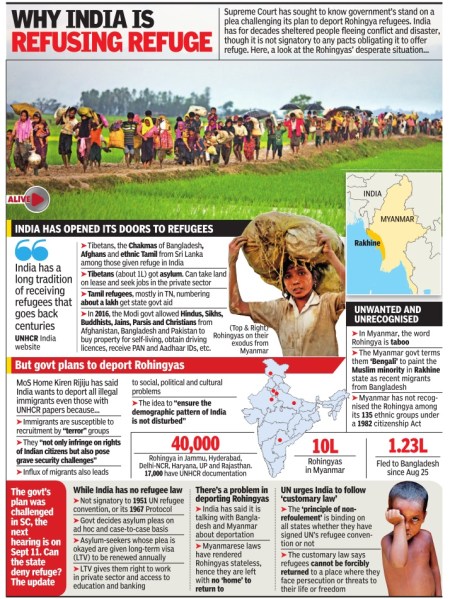
So, India has decided to send around 40,000 Rohingyas back to Myanmar. Around 16,500 Rohingyas, who received refugee cards from the UNHCR, will also have to leave the South Asian country. According to Rijiju, UNHCR may have recognised them as refugees, but the UN body didn’t sign any such treaty with India. As a result, the Indian government is not obliged to accept the recognition given by the UNHCR, argued the minister.
Some Indian foreign policy experts, too, back the government’s decision, as they are of the opinion that it’s important for the global community to put the Myanmarese government under pressure over the Rohingya issue. Other countries will have to work with the Myanmarese government and to send shiploads of aid. But, they cannot solve the crisis by importing people. Ask Europe, say experts.
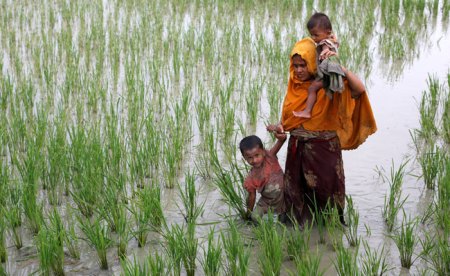
Meanwhile, the UNHCR has strongly criticised the Indian government for its decision to send Rohingyas back to Myanmar, saying that it is not important for a country to sign a refugee-related agreement with the UN. According to the UN agency, no country can put anyone in the face of death and such a move is considered as a violation of international human rights law.
Rohingyas don’t understand international law or foreign policy. They, too, want to return to their homeland. But, they know that they will be in danger, if they go back to their country. Nurjahan recalled that she had left her home only to survive. “Since my birth, I have seen that people are being killed and their houses were burnt by the government officials. They say that we are not citizens of Myanmar. Somehow, I managed to cross the river and entered Bangladesh. Then, a lady helped me arrive in India. But, the Indian police detained me and my sister, and sent us to a home,” she said.
Who will listen to this grief of Rohingyas? The governments of Myanmar, Bangladesh and India have closed the door for them. All of a sudden, Rohingyas become a ‘stateless’ community. The Rohingya issue is undeniably a massive humanitarian disaster and such a disaster should be addressed by the global community immediately.
Boundless Ocean of Politics on Facebook: https://www.facebook.com/boundlessoceanofpolitics/
Boundless Ocean of Politics on Google Plus:
https://plus.google.com/+KoushikDasboundless
Boundless Ocean of Politics on Twitter:
https://twitter.com/kousdas?s=09
Contact us: kousdas@gmail.com

 ISMC
ISMC Boundless Ocean Of Politics