

India Should ‘Correctly’ Recognise China
India and China recently reached an agreement on the Doklam conflict and withdrew their armed forces from the region in order to maintain peace. People of the two neighbouring countries and the global community have welcomed the move and congratulated both New Delhi and Beijing. Although the two nuclear powerful neighbours restored peace in the last week of August, no one can guarantee that there will be no conflict between the two in near future.
There is no doubt that China takes an aggressive approach to others as far as its foreign policy is concerned. Since achieving economic success under the leadership of Deng Xiaoping, Beijing has been trying hard to dominate the global geopolitics. And the Asian giant has successfully demonstrated its internal growth and stable financial situation.
During his visit to India in April 2005, then Chinese Prime Minister Wen Jiabao signed an agreement that included political beliefs and instructions for settling issues related to the Indo-China border disputes. It was clearly mentioned in the agreement that Arunachal Pradesh (the north-eastern Indian province), especially Tawang, would be considered as a part of India. But, then Indian Minister of External Affairs Pranab Mukherjee realised that China was not eager to respect the agreement in June 2007 when the Chinese foreign minister told the former that any argument based on the presence of permanent population could not diminish China’s ‘legitimate’ demand.
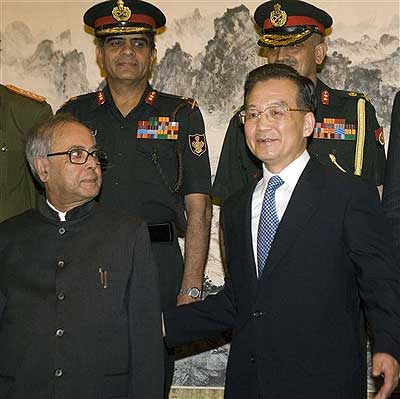
Wen Jiabao & Pranab Mukherjee
Before the arrival of former Chinese President Hu Jintao in India in 2006, then Chinese Ambassador to New Delhi Sun Yuxi announced that Arunachal Pradesh was part of China. At that time, Mukherjee told the Indian Parliament that he rejected the Chinese argument and would made it clear that Arunachal Pradesh is an integral part of India during his meeting with President Hu.
In May 2007, a 107-member delegation of Indian administrative officers was supposed to visit China. However, Beijing refused to issue a visa to one of the members of the delegation as he belonged to Arunachal Pradesh. Later in January 2008, then Indian Prime Minister Dr Manmohan Singh decided to visit Tawang during his trip to Arunachal Pradesh. Just before Dr Singh’s arrival in the Indian province, Beijing issued a statement, saying that the Indian PM could not visit Tawang because it was a controversial area.
India has always tried to maintain friendly ties with its northern neighbour. After the Sino-Indian war in 1962, Rajiv Gandhi was the first Indian PM to visit China in 1988. In his ‘My China Diary (1956-88)’, then External Affairs Minister of State Natwar Singh mentioned that PM Gandhi told him: “I do not have a hang-up of 62. I will visit China. Get ready.”
Nearly 34 years after Gandhi’s visit, another Indian PM Atal Bihari Vajpayee visited Beijing (in 2003). Vajpayee’s visit was a ‘successful’ one, as China recognised Sikkim as a part of India. India, too, recognised Tibet as a part of China. However, Beijing refused to change the position of Sikkim on its map after Vajpayee’s visit. China once again raised the Sikkim issue when Mukherjee visited Beijing in June 2008. Even, then Chinese premier cancelled his scheduled meeting with the visiting Indian minister.

Vajpayee & Hu Jintao
China has always tried to put India under pressure in order to corner its neighbour in the region and to gain greater diplomatic mileage. The Asian giant’s main aim is to keep India embarrassed and disturbed. India’s first Prime Minister Jawaharlal Nehru had tried to maintain cordial ties with China and only after the 1962 Sino-Indian war, he realised that he made a mistake. Current Prime Minister Narendra Modi is a seasoned politician. He rightly decided to prepare his foreign policies on the basis of political reality and to concentrate on national security. PM Modi is well aware of the fact that his government will have to adjust its foreign policies accordingly in order to tackle “aggressive” China.
Now, India cannot afford to make a mistake and should recognise China correctly. During his meeting with PM Modi on the sidelines of the BRICS Summit on Tuesday, Chinese President Xi Jinping said that Beijing would take all the necessary steps to maintain ‘cordial’ ties with India and to ensure peace in the region. However, China can change its stance at any time and trigger a fresh tension. PM Modi should be prepared to tackle Beijing in such a situation.
Boundless Ocean of Politics on Facebook: https://www.facebook.com/boundlessoceanofpolitics/
Boundless Ocean of Politics on Google Plus:
https://plus.google.com/+KoushikDasboundless
Boundless Ocean of Politics on Twitter:
https://twitter.com/kousdas?s=09
Contact us: kousdas@gmail.com

 ISMC
ISMC Boundless Ocean Of Politics