

It’s Just The Beginning
While delivering a landmark judgement on privacy on August 24, nine judges of the Indian Supreme Court (SC) said: “The old order changeth, yielding place to new.” The nine-member SC Bench used Alfred Tennyson’s famous quote at the end of its 547-page verdict. The bench did so to make it clear that the word ‘order’ has two meanings – old arrangements and old instructions.
Since the 1950s, the SC has tried hard to explain whether the ‘Right to Privacy’ of a person should be considered as a fundamental right. In the past, some judges refused to accept the ‘Right to Privacy’ as a fundamental right, while others indirectly expressed an opposite view. However, the SC bench overturned earlier rulings on August 24 and unanimously declared privacy a fundamental right, stressing that it’s intrinsic to ‘right to life and personal liberty’.
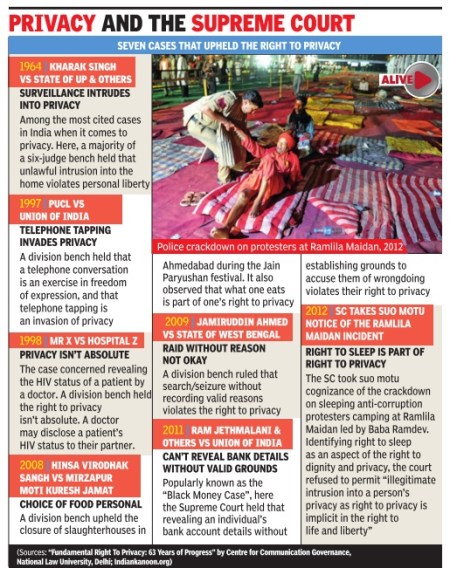
With the judiciary making a serious attempt to change the old order, people across the country have welcomed the verdict. In fact, the ‘new India’ desperately wanted to change the old order.
From personal preferences to public data, the highest court’s order has far-reaching implications. The SC’s latest stand on privacy is very important because of three reasons. According to the verdict, privacy includes at its core the preservation of personal intimacies, the sanctity of family life, marriage, procreation, the home and sexual orientation. As per the judgement, privacy also connotes a right to be left alone. It safeguards the individual autonomy and recognises the ability of the individual to control vital aspects of his/her life. All the nine judges also opined that personal choices, governing of a way of life, are intrinsic to privacy.

At the same time, the judges admitted that the expectations of privacy might vary from the intimate zone to the private zone and from the private to the public. They made it clear that privacy could not be lost or surrendered merely because of the individual is in a public place.
Although individual privacy has become a fundamental right in India, the Right to Privacy (like other fundamental rights) is not absolute. That’s why the SC Bench has allowed the government to frame a law restricting this right, provided it is to meet its “legitimate aims”, which include protecting the national security, preventing and investigating crime, encouraging innovation, spread of knowledge and public interest. The highest court said that the law should stipulate a procedure that is just, fair and reasonable. Also, the law must meet the three-fold requirement of legality, legitimate aim of the State and proportionality to ensure a rational nexus between the objects and means adopted to achieve them.
On August 24, nine SC judges delivered six independent judgments. Basically, it was an attempt to judge a multi-dimensional complex issue from different aspects. Perhaps, this is the best possible method to deal with a sensitive issue in a pluralistic democratic society. Interestingly, the final verdict of the six rulings is identical and it shows that even a pluralistic society can have a common foundation, which is morality. Keeping in mind the basis of democratic morality, the nine judges said that the ‘Right to Privacy’ is a person’s ‘natural’ and ‘inalienable’ right that cannot be denied.
By saying so, the judges reminded us that the Indian Constitution is not only person- or individual-centric in a true sense, but it is also committed to protect the individual from ‘powerful’ masses. According to the SC Bench, the basic philosophy of the Indian Constitution is: “The supreme truth is man (individual), there is nothing more important than he is.”
The historic verdict is not the end of the fight, but the beginning of a new era. Although the Executive and the Legislature have welcomed the SC verdict, (perhaps) the ‘most powerful’ State will never allow its people to enjoy the ‘Right to Privacy’ without a fight. We should not forget that the government had consistently called the ‘Right to Privacy’ an amorphous concept, arguing that such a vague concept could not be held to be a fundamental right. “In a developing country, where millions of people are devoid of the basic necessities of life and do not even have shelter, food, clothing or jobs, and are forced to sleep on pavements even in the height of winter and, perhaps, to die, no claim to a Right to Privacy of the nature claimed in this case, as a fundamental right, would lie,” argued the government.
Of course, the new SC order has created new possibilities and opportunities. But, the people will have to fight hard to take advantage of this opportunity and to enjoy privacy.
Boundless Ocean of Politics on Facebook: https://www.facebook.com/boundlessoceanofpolitics/
Boundless Ocean of Politics on Google Plus:
https://plus.google.com/+KoushikDasboundless
Boundless Ocean of Politics on Twitter:
https://twitter.com/kousdas?s=09
Contact us: kousdas@gmail.com

 ISMC
ISMC Boundless Ocean Of Politics