

Modi Should Follow Rajiv, Vajpayee’s Path
Bhola Nath Mullick served as the Director of India’s Intelligence Bureau (IB) from 1948 to 1968. During the Sino-Indian war in 1962, he was always with then Prime Minister Jawaharlal Nehru. In his publication “My Years With Nehru (1948-64)”, Mullick wrote that he had a discussion on China with the Indian premier ahead of the war. During their discussion, Nehru told Mullick: “Many want to know why I am not interested in attacking China. Actually, both the countries are facing various problems. We should resolve those issues first.” The PM did not even imagine that China would attack India. So, he told the IB chief: “They have to cross the great Himalaya to attack India. There is also a possibility of a World War, if China attacks India.” What Nehru actually wanted to say is: no country attacks another, if the goal of the war is not clear.
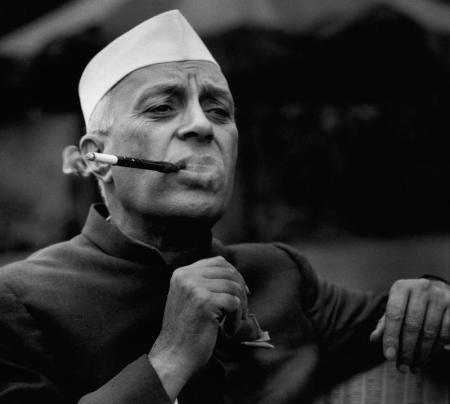
(Nehru)
After becoming the prime minister of India in 2014, Narendra Modi started a romantic journey with Chinese President Xi Jinping. They took a stroll on the picturesque Sabarmati riverfront, sat on a swing and watched traditional folk dances of Gujarat. Now, the romanticism has died and PM Modi is restructuring his policies towards China. The Indian government knows that since the Cultural Revolution, China has been trying hard to increase its influence not only in South-East Asia, but also in South Asia. In fact, former leader Deng Xiaoping wanted China to make a friendship with the global community and to capture the international market in order to ensure a steady economic growth. Similarly, Modi thinks that India should not ‘fear’ China and the Asian giant will think twice before taking any steps against India, if New Delhi takes bold steps.
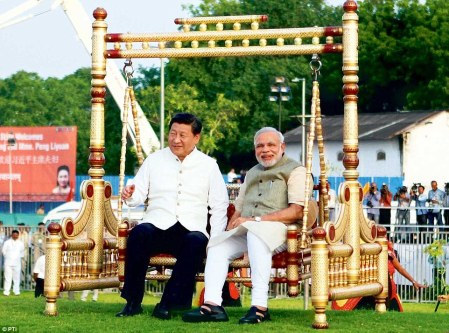
(Modi & Xi)
Of course, there is a political calculation behind this thought. That is the calculation of domestic politics or electoral politics. Ahead of Assembly Elections in Arunachal Pradesh, Modi raised the issue of Chinese infiltration in the north-eastern Indian province and attacked Beijing. Even after his party’s huge victory in the polls, the PM did not change his stance. As a result, domestic politics has started influencing the Modi government’s foreign policies.
It is important for us to consider China’s view on the transformation of India’s policy. The China-India Media Forum was created (in 2013) during the regime of UPA government. A team of Chinese media persons visited New Delhi and met then Indian External Affairs Minister Salman Khurshid to discuss various bilateral issues. China, too, invited Indian journalists to visit Beijing after Modi came to power in 2014. Jayanta Ghosal, a member of the Indian delegation that visited China three years ago, said that the top Chinese leadership was not happy with India’s proximity with the US. According to Ghosal, Beijing wanted India to maintain a “safe distance” with America and to become a “friend” of China. A couple of weeks ago, a senior Chinese diplomat expressed the same view, saying: “We can be competitors, but we can work together in South Asia and Southeast Asia.” Actually, China wants to become a leader in the region and India to be its ‘partner’. But, the basic principle of the Indian foreign policy is “to maintain equidistance”. So, India is eager to maintain cordial ties with both China and the US.
After the Sino-Indian war in 1962, Rajiv Gandhi was the first Indian PM to visit China in 1988. In his ‘My China Diary (1956-88)’, then External Affairs Minister of State Natwar Singh mentioned that PM Gandhi told him: “I do not have a hang-up of 62. I will visit China. Get ready.” Nearly 34 years after Gandhi’s visit, another Indian PM Atal Bihari Vajpayee visited China (in 2003). Even Prime Minister Vajpayee started a new round of discussions with the Chinese leadership to find permanent solutions to the border issue and the two parties appointed special representatives to carry forward the discussion. A joint statement was also issued during Vajpayee’s visit. According to the statement, China will not oppose Sikkim’s status as an Indian province and India will accept Tibet as an integral part of China. Since then, the two Asian neighbours have maintained “friendly” ties.
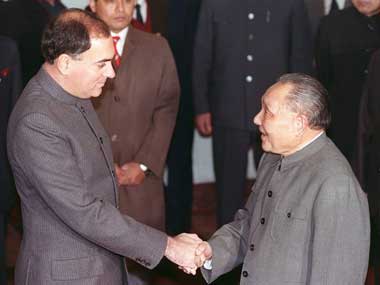
(Rajiv Gandhi & Deng Xiaoping)
Perhaps, it will be better for the Modi government to resolve the ongoing border issue with China through diplomatic channels. There is no need to change “the Indian culture of fear about China”. Beijing has already taken a rigid stand on the border crisis (in Doklam) and the situation will worsen, if India (too) flexes muscles. In fact, opposition parties have advised the Modi government to resolve the issue through diplomacy. During a recent all-party meeting in New Delhi, leaders of various parties said that India should not declare war against China.
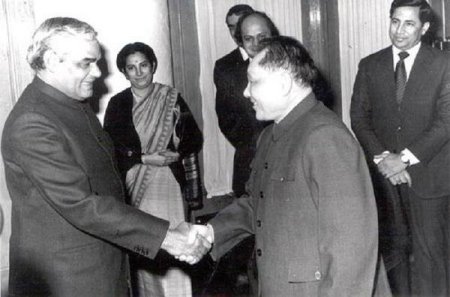
(Atal Bihari Vajpayee & Deng Xiaoping)
During the 1999 Kargil War between India and Pakistan, then Indian Defence Minister George Fernandes said: “China is a bigger enemy than Pakistan.” Then PM Vajpayee immediately ordered Fernandes not to make such comment, saying that it would be foolish to open two fronts at that time. Even today, it is important for India to avoid a two-and-a-half front war. Indira Gandhi knew it, Rajiv Gandhi knew it, Narasimha Rao knew it and Vajpayee most certainly knew it. All of them were well aware of the fact that “the way to handle Sino-Indian friction is to use military power more strategically”. However, Modi somehow doesn’t get it. The PM still has time to return to Rajiv-Vajpayee’s dual diplomatic policy and to resolve the ongoing crisis through peaceful negotiations.
Boundless Ocean of Politics on Facebook: https://www.facebook.com/boundlessoceanofpolitics/
Boundless Ocean of Politics on Google Plus:
https://plus.google.com/+KoushikDasboundless
Boundless Ocean of Politics on Twitter:
https://twitter.com/kousdas?s=09

 ISMC
ISMC Boundless Ocean Of Politics
I absolutely love your blog and find nearly all of your post’s to be exactly what I’m
looking for. Does one offer guest writers to write content for you personally?
I wouldn’t mind composing a post or elaborating on a number
of the subjects you write regarding here. Again, awesome web site! http://www.best-teacher-hometuition.com/index.php/component/k2/itemlist/user/36683
LikeLike
hello there and thank you for your information – I’ve certainly picked up something new from right here.
I did however expertise several technical points using this website, since I experienced to
reload the web site lots of times previous to I could
get it to load properly. I had been wondering if your web host is OK?
Not that I’m complaining, but sluggish loading instances times will sometimes affect your placement
in google and could damage your high quality score if advertising and marketing with Adwords.
Well I am adding this RSS to my email and can look out for a lot more of your
respective intriguing content. Ensure that you update this again very soon.
LikeLike